The walking dead should walk slowly. They should not run. Think of these corpses, raised from slumber by some unknown and incomprehensible force. They are new to this form of locomotion, and their muscles do not respond as expected. Wanton disregard for their own well-being has, in many if not most cases, caused them to sustain multiple injuries. Even if they feel no pain (and “zombies” do not feel pain in the way we do, although they may feel something), they cannot run on a broken ankle, or a torn achilles. Poor zombies.
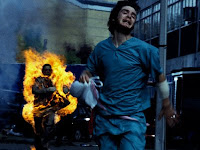
But it seems zombies have been working out. More and more, the undead are portrayed as faster and stronger than the living humans they subsist on. These fast-moving flesh eaters can be scary in their own way, but they are more like the old monsters: werewolves, or yetis, or lions and tigers and bears. They are predators, and we can escape them through our superior wits and technology, but we cannot outrun them, because they are essentially the same beasts we have feared since we first stood up on two legs.
Zombieland’s undead are decidedly in this latter category, the athletic undead.
What makes the living dead of the classic
Night of the Living Dead scary is not simply the fact that have been reanimated. Nor is it their modified cannibalism (Question: is it technically cannibalism when they eat only the flesh of living humans and never each other?), although the images of vacant-eyed undead masticating arm muscle certainly produce some visceral reaction. The truly frightening—and new—thing about Romero’s undead comes from their weakness, the fact that individual zombies are so easily eluded or defeated. It does not matter that you can outrun the shambling corpse in the graveyard—and you certainly can—because there will be another near the car, or behind a tree, or looming up out of the darkness in your front yard. There will always be another.
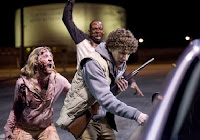
That
Zombieland features zombies who run is a failure not of
Zombieland itself, but of the entire zombie genre to which it is a response.
Zombieland is a movie about zombie movies, and in the cultural contest between high-speed, Danny-Boyle—style undead flesh-eaters and the lumbering living dead of
Night etc, it is pretty clear that the scarier and more interesting slow zombies have already lost.
Zombieland is the proof, because
Zombieland exists in a cultural setting where an explanation of the plague—what caused it, how it spread, where it started—is almost irrelevant, and certainly unnecessary. Everyone knows what a zombie is.
Zombieland is not a bad movie. Every aspect of the film does what it means to do; it is funny, romantic, gory, smart. The performances are strong, especially one awesome (and often spoiled, but far be it from me…) cameo. Here is Jesse Eisenberg, still playing the same thoughtful, neurotic descendant of some hybrid of Woody Allen and Holden Caulfield that he has been playing since he was tiny (and here I am again, sort of liking him in spite of the fact that I was sure I had heard enough stories about how hard it is to be a smart, introspective, adolescent white boy growing up in middle America). And here is Abigail Breslin, who no longer looks like a little girl, trading one-liners with Woody Harrelson.
Like in the superior
Shaun of the Dead, the zombies in
Zombieland are mere background, in this case for a family road-trip action comedy (sort of like a
National Lampoon’s Summer Vacation, with automatic weapons). Unlike
Shaun of the Dead,
Zombieland has no rough edges. It is slick and fast and full of self-confidence. Maybe that is the difference between the zombie movies
Zombieland is responding to and the Romero family of zombie movies (which
SotD is about); Romero gleefully explores a crazy idea, while the fast-zombie movies are sardonic and a little smug, and their underlying idea is ultimately safe.
For lovers of
Night of the Living Dead, there is something sad about
Zombieland. It feels like a nail in the coffin of the thing Romero invented, which was maybe the first new thing in horror in a century. The shambling, slack-jawed, vacant-eyed animated corpse that feeds on the flesh of the living, that can be killed with a shotgun blast or a good solid blow to the head, that can be outrun by any child, but can never be defeated because the one thing this threat requires to keep coming is the one thing we will never stop providing: more corpses.
 On to the list. The first night consists of the latest films, which I think are the same film or at least the same ending. The second night will be a date night, third night - westerns, the fourth night - a battle of Johns (Turturro and Goodman), and the fifth night on the dangers of industry. The sixth night will be all about Frances and the final night will be my favorite of bunch.


