On Wednesday, instead of the usual ritual viewing of Heroes and TUF on Charlie’s DVR, Kristin and Charlie and I went to Gus Van Sant’s new biographical movie about Harvey Milk.
Milk was SO GOOD. It was really interesting and compassionate and beautiful. The acting was good, and that seems to be what everyone is talking about, but what I really liked about it was the way the story was constructed. I mean, there are TONS of historical documents about these events (and a lot of the people involved are still around and aware of the movie). The movie uses the historical record – lots of old footage, including this amazingly moving scene of the candle light vigil after Harvey Milk died – but it totally avoids feeling like a documentary. There’s tons of framing: stories inside of stories, levels of narration, and distortions – I lost count of how many times what we’re watching is not the action but a reflection of the action, in a window or a mirror or a TV screen or even in an extreme close-up of one of the whistles gay men used to carry in the Castro in case they were attacked. I am pretty sure several of these shots didn’t even make sense physically, and it was these odd angles and unlikely perspectives that for me made Milk less a movie about a life than a movie about how hard it is to make a movie about a life.
It had a lot of the SUPER cheesy stuff that usually makes me indifferent to these big Oscary biopics, but it justified even those moments somehow, in part because of the constant assertion of credibility* and in part because of the corniness of Harvey Milk himself - without unfailing and doomed optimism, he would not have been the hero he was.
*One of the corniest scenes in the movie is when, in the final moments of Milk’s life,he stares out the window at the Tosca posters across the street. Well, it turns out there's a lot of good reason to believe that he was actually staring out the window at the opera house when he died.
Friday, December 19, 2008

Tuesday, December 16, 2008
Twilight--David's Initial Response
My partner and I finally saw twilight today, which inspired me to make the following game. I'm going to show you pairs of pictures, and you're going to try to figure out which one is Marlon Brando looking young and sexy, and which is Robert Pattinson. I claim that this is impossible. To make the game harder for me, I picked only pictures off of the first page of Google Images:
Ready?
Here we go:

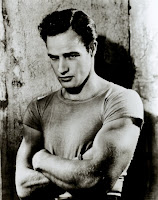
ANSWER: Actually, Brando's on the right.
Here's an easy one:


ANSWER: There's a trick to this one. I didn't have time to airbrush the cigarette.
Okay, one more:


ANSWER: I don't remember any more which is which in this one. Sorry. But does it really matter?
My partner notes that Pattinson is much skinnier than Brando in each of these pictures, and while I agree, I observe that age will fatten his jowls, but won't do anything to decrease his eyebrows, his pouty lips, his beauty, or his troubled manly gaze.
Ready?
Here we go:


ANSWER: Actually, Brando's on the right.
Here's an easy one:


ANSWER: There's a trick to this one. I didn't have time to airbrush the cigarette.
Okay, one more:


ANSWER: I don't remember any more which is which in this one. Sorry. But does it really matter?
My partner notes that Pattinson is much skinnier than Brando in each of these pictures, and while I agree, I observe that age will fatten his jowls, but won't do anything to decrease his eyebrows, his pouty lips, his beauty, or his troubled manly gaze.
Monday, December 15, 2008
Awards Season: Handmade Edition
I have all sorts of ranty feelings about awards and awards seasons and awards predicting and awards shows. I sort of hate the Oscars, but I guess I sort of hate them in the same way I sort of hate Buffy. I mean, I own the whole series, and I've watched it a lot of times, and I have so many opinions about niggling details, you might think I'm some sort of a "fan" or whatever. Like a lot of people who Hate The Oscars, I cannot seem to help paying a fair amount of attention.
I hate many things about The Academy. They usually reward movies I find more or less unbearable. They perpetuate the homogenization of the movies and the star system which deprives us of access to lots of talent. And there is something weird and wrong about the idea that what is supposed to be art can be lined up in order, worst to best, with exactly one movie at the top. The main thing I hate is this idea, that there is one "best." It prevents comedy from ever being recognized, of course. And it excludes other good movies too. I would prefer a diversification of awards, which I guess is a direction we're heading in (with the addition of animated feature, foreign language, shorts, etc), but I want to go further. Much further. I would like to see a category for Best Performance By An Established Actor Playing Against Type, or Best Movie That You Wouldn't Expect To Be Good, or Best Non-Condescending Writing of a Slangy Teen. And rename the "best picture" what it really is: Best Very Dramatic, Moderately Politically Movie Set In The Past With At Least One Hard-to-Place Accent and At Least One Main Character Who Dies Unpleasantly.
Anyway, it is in this spirit that Not That Critical presents the first annual HandMade Awards, honoring the films of 2008 (that I happen to have seen) that best capture the spirit of hand crafting and/or promote crafts, especially fiber arts.
5. Wanted
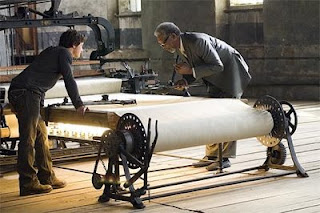
What could be better than an action movie, based on a comic book, full of sexiness and weaving? Well, Wanted doesn't answer that question, because it was pretty much none of those things. But I still give it a place on the list, for trying to make weaving edgy.
4. Twilight
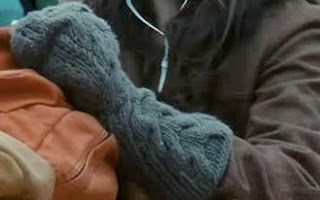
We've already written a fair amount about Twilight. But we haven't talked about Bella's lovely mittens, which have inspired a lot of fan crafting. They are very pretty, in a muppety sort of way.
3. Role Models
Role Models was a pretty good movie, and I found its portrayal of nerdy LARP/SCA culture pleasantly affectionate (if probably inaccurate). The crafty high point of the film is the arrival of the four main characters decked out in homemade KISS costumes. Homemade!
Also: McLovin sews!
2. Dr Horrible's Sing-a-long Blog
http://community.livejournal.com/weloveamigurumi/344530.html
Dr. Horrible deserves a hand-made award for several reasons. First, Joss Whedon has inspired TONS of fan crafting over the course of his career. Dr. Horrible was produced independently and released free online (and now it's free on Hulu) which is in itself very much in the DIY spirit. Finally, Joss Whedon graciously granted an interview to Kim Werker of crochetme.com, in which he took the idea of craft seriously and gave good answers to good questions.
1. Happy-Go-Lucky
 Mike Leigh's lovely improvisational comedy Happy-Go-Lucky gets the award, largely on the strength of that ridiculously wonderful sweater vest.
I hate many things about The Academy. They usually reward movies I find more or less unbearable. They perpetuate the homogenization of the movies and the star system which deprives us of access to lots of talent. And there is something weird and wrong about the idea that what is supposed to be art can be lined up in order, worst to best, with exactly one movie at the top. The main thing I hate is this idea, that there is one "best." It prevents comedy from ever being recognized, of course. And it excludes other good movies too. I would prefer a diversification of awards, which I guess is a direction we're heading in (with the addition of animated feature, foreign language, shorts, etc), but I want to go further. Much further. I would like to see a category for Best Performance By An Established Actor Playing Against Type, or Best Movie That You Wouldn't Expect To Be Good, or Best Non-Condescending Writing of a Slangy Teen. And rename the "best picture" what it really is: Best Very Dramatic, Moderately Politically Movie Set In The Past With At Least One Hard-to-Place Accent and At Least One Main Character Who Dies Unpleasantly.
Anyway, it is in this spirit that Not That Critical presents the first annual HandMade Awards, honoring the films of 2008 (that I happen to have seen) that best capture the spirit of hand crafting and/or promote crafts, especially fiber arts.
5. Wanted

What could be better than an action movie, based on a comic book, full of sexiness and weaving? Well, Wanted doesn't answer that question, because it was pretty much none of those things. But I still give it a place on the list, for trying to make weaving edgy.
4. Twilight

We've already written a fair amount about Twilight. But we haven't talked about Bella's lovely mittens, which have inspired a lot of fan crafting. They are very pretty, in a muppety sort of way.
3. Role Models

Role Models was a pretty good movie, and I found its portrayal of nerdy LARP/SCA culture pleasantly affectionate (if probably inaccurate). The crafty high point of the film is the arrival of the four main characters decked out in homemade KISS costumes. Homemade!
Also: McLovin sews!
2. Dr Horrible's Sing-a-long Blog
http://community.livejournal.com/weloveamigurumi/344530.html
Dr. Horrible deserves a hand-made award for several reasons. First, Joss Whedon has inspired TONS of fan crafting over the course of his career. Dr. Horrible was produced independently and released free online (and now it's free on Hulu) which is in itself very much in the DIY spirit. Finally, Joss Whedon graciously granted an interview to Kim Werker of crochetme.com, in which he took the idea of craft seriously and gave good answers to good questions.
1. Happy-Go-Lucky
 Mike Leigh's lovely improvisational comedy Happy-Go-Lucky gets the award, largely on the strength of that ridiculously wonderful sweater vest.
Friday, December 12, 2008
Twilight (Lydia's response)

(Edward and Bella try very hard not to make out)
First, I would like to get out of the way some of my political response to this movie:
1. Twilight should be part of an abstinence-only sex ed
curriculum. Again and again, the following message is reiterated: if you lose control of your natural desires, if you pursue the pleasure you want for even a second, you will quite literally die a horrible death.
2. It is a textbook abusive relationship:
- Bella overlooks Edward's bad behavior because she loves him so much.
- Only she can see how beautiful he really is (because he only shows his glitter-paint on the top of the mountain to her).
- He isolates her from her family (and says it's best for them if she ends her relationship through painful lies).
- He blames her (and her attractiveness, and how much he loves her) for his desire to physically assault her.
- He shyly admits that he's been sneaking into her room because he likes to watch her sleep. In real life, this sort of behavior is categorically NOT cute or endearing.
- When she says she's not afraid of him he replies "You shouldn't have said that" and proceeds to do his best to scare the shit out of her. How sweet.
If you look at Catherine Hardwicke's career, you will notice that directing is not her biggest credit. She has been production designer on about three times as many films as she has directed. Look at what CH has directed though: the powerful and hard to watch Thirteen, which she co-wrote with then-thirteen-year-old actress Nikki Reed who plays (unfortunately few scenes as) this bitchy/hungry vampire in Twilight. Between Thirteen and Twilight, Hardwicke directed two other teen movies I have not seen, with two other, very different stories of teen life: The Lords of Dogtown, which is about California surf culture in the 70s, and The Nativity Story, which is...the nativity story. (I did not see this movie, and now I kind of want to. I think the only reason I remember it at all is because there was some understated controversy around the fact that Keisha Castle-Hughes -- you remember her from Whale Rider -- was herself a pregnant unmarried teen during the time she played pregnant unmarried teen Mary. Irony? Or something...?)
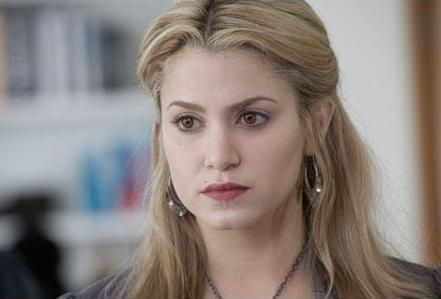
Twilight captures a sort of absurd, sincere emotion that exists only in impossibly intense teen relationships. The endless gray background, the modest overacting, and the simplicity of the characters all contribute to this honest excess. Kristen Stewart's performance comprises mostly earnest lip-biting and sullen-but-mature voice over narration, while Robert Pattinson as Edward reminds me a little of Danny Zuko, asserting his masculinity with every swaggering step. The supporting characters, while they lack dimension I suppose, refreshingly refuse to conform exactly to the age old dichotomies of high school life: nerd vs jock, rebel vs princess. I give Twilight credit for surrounding Bella with a group of friends each of whom is some degree of nerdy, athletic, clever, likable and self-possessed.

I love the way symbolism is slathered all over the surface of this movie. There is nothing subtle about Twilight (just as there is nothing subtle about being seventeen and hopelessly and tragically in love in ways no one else could possibly understand). Bella's first interaction with Edward takes place in front of a convenient fan, a fan that blows her hair back as if she were in a music video. In much of this scene, Edward's face is perfectly framed by the outstretched wings of a stuffed owl: cherubic and nocturnal.
I have only read the first twenty pages of the Stephanie Meyers novel on which Twilight is based; it is exactly the sort of book (best-selling, plot-driven and extremely long) I tend to avoid for fear of having to explain why I hated it to likable smart fun people who loved it. But actually, from the beginning of the book, I suspect Twilight may prove to be an exception. Maybe the first person narrative justifies the sloppy writing in this case? Bella lacks self-awareness and while this is probably not craft (a couple of interviews have convinced me that S Meyers lacks any pretense of being interested in, you know, words or whatever), but it works. Sure, I am disappointed that Meyers (like JK Rowling) achieves celebrity while Jaclyn Moriarity remains unheard of, even among avid kidlit readers, but it is unfair to judge a work by what it is not.
p.s. I enlightened a lot of people by making (less elegantly) this connection after (okay, and during) the movie. I love the internet!
Wednesday, December 10, 2008
Paris, je t'aime

Jardin State.
In the spirit of the film, my review will be in a series of short reviews.
“Place des Victoires”: This is a standard grief-piece: a mother is quickly revealed to have lost her son and is fixating on little details while her husband and daughter urge her to come to terms. While this is to all appearances the dullest of the shorts (though by no means the worst), it features a magic cowboy at the end (Willem Defoe!) and accordingly it really just works.
Bob Hoskins: This guy is great. Like the best character actors he captures the utter cartoonishness necessary to make acting watchable without overstepping into whatever bad comedians are. In many ways he is a better summation of the human experience than a whole funny drama about love and loneliness: he is just too absurd to be believable, just too convincing to be a joke and just too likeable to be criticized.
“Quartier de la Madeleine”: PJT’A doesn’t qualify as eighteen short films since this one is really just part of Sin City. Short. Noir. Ambient. Black-and-white-but-for-stylized-blood. Elijah Wood is even in it. However you felt about Sin City, here’s part of it again but with a heart wipe to black so it doesn’t feel out of place.
(It feels a little out of place.)
Colgate Tartar Control Whitening: I brushed my teeth with this after the movie. It has a granular quality that I find unpleasant. It’s as though in staving off the erosion of my teeth by sugar and age it is in turn eroding them the traditional way. This is an unnerving thing to consider, especially during the only five minutes a day you spend in front of a mirror. I’m not sure toothcare providers realize uniquely introspective window of captive audience.
“14e arrondissement”: The final section is a journal entry by a middle-aged American tourist, narrated aloud in obviously amateurish French. While this is a film about Paris that ends on an American’s experience, it avoids coloring the film as strictly American; in fact ending with a foreigner’s experience of the city feels like a fitting way to give it an identity. The difficulty with this section is the intentional superficiality of her commentary. Lines like “I wish that I had someone with me. Someone to say to, ‘this is beautiful,'” would stand out awfully from an earnest character, but clearly meant to be meaningful and self-aware from a simple, bewildered one. Since the movie knows she is simple it is either being ironic or celebrating it. The former would be mean-spirited and contrary to the presentation of Paris as a beautiful, wonderful place while the latter would embrace all experiences as equally deep, contrary to the idea of Paris as complicated and layered (a problematic thing to suggest about the subject of your movie). I doubt Alexander Payne finds cinematic value in actual tourist slides, yet has seen it in fabricating and producing one. In all, it seems to rest between irony and sincerity: one must simultaneously understand and condescend this poor wonderful woman, or feel not taken the correct amount of seriously.
The Idaho State Quarter: I don’t understand what is going on here. There is a monstrous hawk, giving the entire state of Idaho (disturbingly severed from the rest of the continental 48) the hungriest look. If anyone can come up with a more reasonable reading I’d be glad to hear it but for now I’m going to stay out of Idaho.
Paris, je t’aime: In many ways this movie is exactly what you would expect. It is likeable, funny, sad and visually cool. It is strange that there is a prevailing feeling of optimism in a drama where half the shorts are tragic. There is a sense that the movie wants to make loneliness beautiful simply by showing it, which I don’t fully understand. Any movie about a city is called a love letter to that city, and a brief survey of online reviews show Paris je t’aime no different. In its ambivalence about the relationship of joy, sadness, heatbreak and quirkiness beyond their constant presence it perhaps is a love letter. Of course, a love letter is almost always one of two things: a happy affirmation of the obvious or untimely, unwanted, and unread. To make a film of one seems odd.
Sunday, December 7, 2008
Ho Ho Horror Part 1: Gremlins (1984)

Last night Kristin, Lydia, and I decided to celebrate the season with a night of "ho ho horror." With Silent Night, Deadly Night (1984) and Black Christmas (1974), all we wanted was the classic Christmas horror comedy Gremlins (1984) to complete the trio. At nearly every video store we received the same dire news: "Gremlins is out," before locating a copy at the Cinemat. Of course, it was a popular movie. What child of the eighties could forget Gizmo's adorable chirping, cruel Mrs. Deagle propelled out of her bedroom window, or the Gremlins' taste for, well, just about anything (as Lydia pointed out, never before had "yum yum" been uttered so menacingly). But watching to movie as an adult, I soon came to realize that Gremlins was a remarkable sign of the times, consciously referencing the early 1980s recession, the booming film industry, the normalization of Sino-American relations and the consequent fear of an invasive, rapidly multiplying hordes of technologically-oriented Other.
The economic plight of the ordinary residents of Kingston Falls, contrasted sharply with Mrs. Deagle's pursuit of money for money's sake ("The bank and I have the same purpose in life - to make money"), centers around scenes of the aptly named "Savings & Loan" bank, in an almost painfully obvious reference to the savings and loan crisis which began with billion-dollar losses from 1980 to 1982. As Mrs. Deagle tramples upon her less-fortunate neighbors, the lovable, middle-class, boy-next-door hottie Billy Peltzer (Zach Galligan - who now has a blog) is threatened with unemployment. His father, Randall Peltzer, is an inventor who spends much of the movie tinkering in the basement, peddling his wares, and attending an inventors' convention where his "bathroom buddy" is one-upped by a real-life time machine and a humanoid robot. The family simply cannot afford not to work during the holidays.
The economic disparity between Mrs. Deagle and "the bank" and the ordinary residents of Kingston Falls is mise en abyme when Billy returns home to find his mother slaving away in the kitchen while watching It's a Wonderful Life. While Frank Capra's film is such a holiday standby that it does not seem at all out of place in a movie that takes place at Christmas, who can resist comparing Bedford Falls and Kingston Falls? Mr. Potter's disregard for human life and Mrs. Deagle's equally revolting treatment of others? I don't want to force the comparison; what is more striking is that Mrs. Peltzer is watching the television in the kitchen. Television and cinema is so ubiquitous that one might be tempted to argue that the truly pervasive threat in Gremlins is not an army of little green men, but the omnipresence of visual media. From the kitchen screening of It's a Wonderful Life to Billy watching Invasion of the Body Snatchers to the gremlins' Snow White sing-along, the movie is, as Kristin put it, "so meta." Nowhere is the film more meta-cinematic than in the gremlins' appreciation and appropriation of Hollywood. At the movie theater, the gremlins are captivated by Snow White. But their fascination is not that of a foreigner looking in, but of a dyed-in the wool cinephile: they sing along with the seven dwarves, feast on popcorn, and request Milk Duds (does anyone eat these things outside of the theater?). Earlier, at the town bar, one gremlin stands out as he so consciously embodies film noir: brooding in a corner surrounded by smoke and sporting a fedora. In more than once instance, film seems to become reality. The gremlins' transformation is foreshadowed by the hatching pod scene from Invasion of the Body Snatchers. At the theater, when Snow White ends, the shadows of the angry gremlins are projected onto the back of the movie screen before they literally tear through it. During the final confrontation in the toy store, Gizmo hops into a hot pink Barbie car to save Billy and Kate from head gremlin Stripe and cruises through the store as we here Clark Gable's voice entone: "It takes a certain kind of guy. And that guy needs a certain kind of dame" in a reference to Clarence Brown's To Please a Lady (1950), where Gable plays a race car driver. Gizmo, like the noir gremlin at the bar, imagines himself in a fictional role. As perfect consumers of media, could the gremlins be a criticism of the public's thirst for film? At the end of the movie, Mr. Wing notices Gizmo's attention to the television and asks, astonished: "You let him watch television? Aiiiee yah! (Gremlins does not want for caricatures of Asian people)."
Or is the film critical of the public's thirst for movie merchandise, the mass-produced t-shirts, lunchboxes, action figures, stickers, etc. that followed in the wake of Star Wars and E.T.? Could the gremlins' menacing "yum yum" mean to echo our own gluttonous consumerism? In some ways, the gremlins resemble Romero's uber-consumer zombies in Dawn of the Dead (1978), indulging an insatiable appetite and leaving a wake of destruction. A quick glance at the Wikipedia entry for Gremlins reveals that more than one critic has noted satirical elements in the gremlins' gluttony. Maybe I am giving the film more credit than it deserves, but the constant references to film represent its best, albeit heavy-handed, satire. It is just as easy to watch the gremlins guzzle beer, stuff themselves with candy, and smoke packs of cigarettes and safely judge their adolescent misbehavior as it is to watch Romero's zombies gorge themselves on the living and frown upon mindless consumerism. It is much harder to pass judgment on a medium in which one is directly implicated.
But if Gremlins succeeds in commenting upon America's love-affair with cinema, it uncritically reproduces the most upsetting stereotypes of Asians and ultimately vindicates Mr. Futterman's xenophobia. From the outselt, Mr. Futterman decries the worthlessness of foreign cars ("they always freeze up on you") and seethes at the sight of subtitles ("Goddamn foreign TV"). Gremlins, as legend would have it, are mischievous and technologically-savvy creatures with a penchant for sabotaging aircraft. For Mr. Futterman, they are the hallmark of foreign technology: "You gotta watch out for foreigners.They plant gremlins in their machines. The same gremlins brought down our planes in the big one." The "big one" is WWII and the gremlins in question Axis sympathizers. For Mr. Futterman, the war continues as German and Japanese cars invade the American market. His fears are realized as gremlins toy with his TV antenna, bringing French (who can think of a more un-American culture?!) into his living room, and then take the wheel of a snow plow and run over Mr. and Mrs. Futterman. In 1979 Deng Xiaoping visited Washington D.C. and later that year China and the USA established bilateral relations after years of shaky diplomacy. For xenophobes like Mr. Futterman, this must have amounted to sleeping with the enemy. Gremlins would soon overrun the US. And how. The gremlins adapt perfectly to American culture. Like a modern-day Trojan Horse, Randall Peltzer's gift to his son allows the enemy to attack from within. Falling back on the narrative of consumerism, Randall insisted that he had to have the mogwai, whatever the cost. Mr. Wing's grandson made the deal behind his back because they "need the money." And so a back-alley financial transaction between an American businessman and a Chinese shopkeeper results in the realization of Mr. Futterman's gremlin nightmares.
What puzzled Kristin and me was the appeal of Gremlins today. Perhaps, tied as it is to the recession of the 1980s, viewers in 2008 can project their own economic worries onto the movie. "With mogwai comes much responsibility!" admonishes Mr. Wing at the beginning and end of the film. I cannot help but see in the little green (like the dollar) monsters the horrors of financial deregulation (capitalism run amok). Born of an illicit financial transaction, the gremlin invasion thrives on unscrupulous handling. Of course, much of its appeal may also lie in its kitschiness. Like other eighties blockbusters, Gremlins produced enough box-office revenue and enough merchandise to earn itself a place in the annals of American pop culture.
Despite the dull acting, the bad special effects, and the cheesy synthesizer theme-song, Gremlins is a great movie, at once representative of the 1980s zeitgeist and sufficiently "meta" to entertain cinephiles and armchair film theorists.
Subscribe to:
Posts (Atom)