On Wednesday, instead of the usual ritual viewing of Heroes and TUF on Charlie’s DVR, Kristin and Charlie and I went to Gus Van Sant’s new biographical movie about Harvey Milk.
Milk was SO GOOD. It was really interesting and compassionate and beautiful. The acting was good, and that seems to be what everyone is talking about, but what I really liked about it was the way the story was constructed. I mean, there are TONS of historical documents about these events (and a lot of the people involved are still around and aware of the movie). The movie uses the historical record – lots of old footage, including this amazingly moving scene of the candle light vigil after Harvey Milk died – but it totally avoids feeling like a documentary. There’s tons of framing: stories inside of stories, levels of narration, and distortions – I lost count of how many times what we’re watching is not the action but a reflection of the action, in a window or a mirror or a TV screen or even in an extreme close-up of one of the whistles gay men used to carry in the Castro in case they were attacked. I am pretty sure several of these shots didn’t even make sense physically, and it was these odd angles and unlikely perspectives that for me made Milk less a movie about a life than a movie about how hard it is to make a movie about a life.
It had a lot of the SUPER cheesy stuff that usually makes me indifferent to these big Oscary biopics, but it justified even those moments somehow, in part because of the constant assertion of credibility* and in part because of the corniness of Harvey Milk himself - without unfailing and doomed optimism, he would not have been the hero he was.
*One of the corniest scenes in the movie is when, in the final moments of Milk’s life,he stares out the window at the Tosca posters across the street. Well, it turns out there's a lot of good reason to believe that he was actually staring out the window at the opera house when he died.
Friday, December 19, 2008

Tuesday, December 16, 2008
Twilight--David's Initial Response
My partner and I finally saw twilight today, which inspired me to make the following game. I'm going to show you pairs of pictures, and you're going to try to figure out which one is Marlon Brando looking young and sexy, and which is Robert Pattinson. I claim that this is impossible. To make the game harder for me, I picked only pictures off of the first page of Google Images:
Ready?
Here we go:

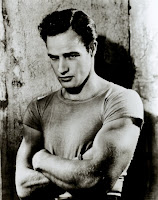
ANSWER: Actually, Brando's on the right.
Here's an easy one:


ANSWER: There's a trick to this one. I didn't have time to airbrush the cigarette.
Okay, one more:

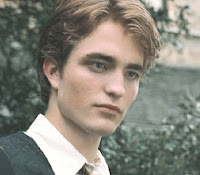
ANSWER: I don't remember any more which is which in this one. Sorry. But does it really matter?
My partner notes that Pattinson is much skinnier than Brando in each of these pictures, and while I agree, I observe that age will fatten his jowls, but won't do anything to decrease his eyebrows, his pouty lips, his beauty, or his troubled manly gaze.
Ready?
Here we go:


ANSWER: Actually, Brando's on the right.
Here's an easy one:


ANSWER: There's a trick to this one. I didn't have time to airbrush the cigarette.
Okay, one more:


ANSWER: I don't remember any more which is which in this one. Sorry. But does it really matter?
My partner notes that Pattinson is much skinnier than Brando in each of these pictures, and while I agree, I observe that age will fatten his jowls, but won't do anything to decrease his eyebrows, his pouty lips, his beauty, or his troubled manly gaze.
Monday, December 15, 2008
Awards Season: Handmade Edition
I have all sorts of ranty feelings about awards and awards seasons and awards predicting and awards shows. I sort of hate the Oscars, but I guess I sort of hate them in the same way I sort of hate Buffy. I mean, I own the whole series, and I've watched it a lot of times, and I have so many opinions about niggling details, you might think I'm some sort of a "fan" or whatever. Like a lot of people who Hate The Oscars, I cannot seem to help paying a fair amount of attention.
I hate many things about The Academy. They usually reward movies I find more or less unbearable. They perpetuate the homogenization of the movies and the star system which deprives us of access to lots of talent. And there is something weird and wrong about the idea that what is supposed to be art can be lined up in order, worst to best, with exactly one movie at the top. The main thing I hate is this idea, that there is one "best." It prevents comedy from ever being recognized, of course. And it excludes other good movies too. I would prefer a diversification of awards, which I guess is a direction we're heading in (with the addition of animated feature, foreign language, shorts, etc), but I want to go further. Much further. I would like to see a category for Best Performance By An Established Actor Playing Against Type, or Best Movie That You Wouldn't Expect To Be Good, or Best Non-Condescending Writing of a Slangy Teen. And rename the "best picture" what it really is: Best Very Dramatic, Moderately Politically Movie Set In The Past With At Least One Hard-to-Place Accent and At Least One Main Character Who Dies Unpleasantly.
Anyway, it is in this spirit that Not That Critical presents the first annual HandMade Awards, honoring the films of 2008 (that I happen to have seen) that best capture the spirit of hand crafting and/or promote crafts, especially fiber arts.
5. Wanted
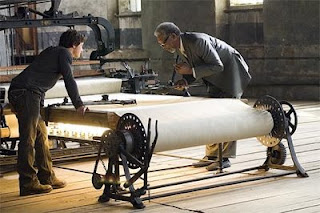
What could be better than an action movie, based on a comic book, full of sexiness and weaving? Well, Wanted doesn't answer that question, because it was pretty much none of those things. But I still give it a place on the list, for trying to make weaving edgy.
4. Twilight
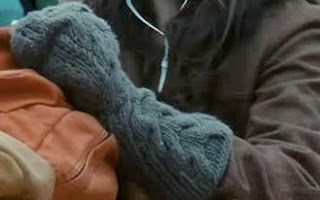
We've already written a fair amount about Twilight. But we haven't talked about Bella's lovely mittens, which have inspired a lot of fan crafting. They are very pretty, in a muppety sort of way.
3. Role Models
Role Models was a pretty good movie, and I found its portrayal of nerdy LARP/SCA culture pleasantly affectionate (if probably inaccurate). The crafty high point of the film is the arrival of the four main characters decked out in homemade KISS costumes. Homemade!
Also: McLovin sews!
2. Dr Horrible's Sing-a-long Blog
http://community.livejournal.com/weloveamigurumi/344530.html
Dr. Horrible deserves a hand-made award for several reasons. First, Joss Whedon has inspired TONS of fan crafting over the course of his career. Dr. Horrible was produced independently and released free online (and now it's free on Hulu) which is in itself very much in the DIY spirit. Finally, Joss Whedon graciously granted an interview to Kim Werker of crochetme.com, in which he took the idea of craft seriously and gave good answers to good questions.
1. Happy-Go-Lucky
 Mike Leigh's lovely improvisational comedy Happy-Go-Lucky gets the award, largely on the strength of that ridiculously wonderful sweater vest.
I hate many things about The Academy. They usually reward movies I find more or less unbearable. They perpetuate the homogenization of the movies and the star system which deprives us of access to lots of talent. And there is something weird and wrong about the idea that what is supposed to be art can be lined up in order, worst to best, with exactly one movie at the top. The main thing I hate is this idea, that there is one "best." It prevents comedy from ever being recognized, of course. And it excludes other good movies too. I would prefer a diversification of awards, which I guess is a direction we're heading in (with the addition of animated feature, foreign language, shorts, etc), but I want to go further. Much further. I would like to see a category for Best Performance By An Established Actor Playing Against Type, or Best Movie That You Wouldn't Expect To Be Good, or Best Non-Condescending Writing of a Slangy Teen. And rename the "best picture" what it really is: Best Very Dramatic, Moderately Politically Movie Set In The Past With At Least One Hard-to-Place Accent and At Least One Main Character Who Dies Unpleasantly.
Anyway, it is in this spirit that Not That Critical presents the first annual HandMade Awards, honoring the films of 2008 (that I happen to have seen) that best capture the spirit of hand crafting and/or promote crafts, especially fiber arts.
5. Wanted

What could be better than an action movie, based on a comic book, full of sexiness and weaving? Well, Wanted doesn't answer that question, because it was pretty much none of those things. But I still give it a place on the list, for trying to make weaving edgy.
4. Twilight

We've already written a fair amount about Twilight. But we haven't talked about Bella's lovely mittens, which have inspired a lot of fan crafting. They are very pretty, in a muppety sort of way.
3. Role Models

Role Models was a pretty good movie, and I found its portrayal of nerdy LARP/SCA culture pleasantly affectionate (if probably inaccurate). The crafty high point of the film is the arrival of the four main characters decked out in homemade KISS costumes. Homemade!
Also: McLovin sews!
2. Dr Horrible's Sing-a-long Blog
http://community.livejournal.com/weloveamigurumi/344530.html
Dr. Horrible deserves a hand-made award for several reasons. First, Joss Whedon has inspired TONS of fan crafting over the course of his career. Dr. Horrible was produced independently and released free online (and now it's free on Hulu) which is in itself very much in the DIY spirit. Finally, Joss Whedon graciously granted an interview to Kim Werker of crochetme.com, in which he took the idea of craft seriously and gave good answers to good questions.
1. Happy-Go-Lucky
 Mike Leigh's lovely improvisational comedy Happy-Go-Lucky gets the award, largely on the strength of that ridiculously wonderful sweater vest.
Friday, December 12, 2008
Twilight (Lydia's response)

(Edward and Bella try very hard not to make out)
First, I would like to get out of the way some of my political response to this movie:
1. Twilight should be part of an abstinence-only sex ed
curriculum. Again and again, the following message is reiterated: if you lose control of your natural desires, if you pursue the pleasure you want for even a second, you will quite literally die a horrible death.
2. It is a textbook abusive relationship:
- Bella overlooks Edward's bad behavior because she loves him so much.
- Only she can see how beautiful he really is (because he only shows his glitter-paint on the top of the mountain to her).
- He isolates her from her family (and says it's best for them if she ends her relationship through painful lies).
- He blames her (and her attractiveness, and how much he loves her) for his desire to physically assault her.
- He shyly admits that he's been sneaking into her room because he likes to watch her sleep. In real life, this sort of behavior is categorically NOT cute or endearing.
- When she says she's not afraid of him he replies "You shouldn't have said that" and proceeds to do his best to scare the shit out of her. How sweet.
If you look at Catherine Hardwicke's career, you will notice that directing is not her biggest credit. She has been production designer on about three times as many films as she has directed. Look at what CH has directed though: the powerful and hard to watch Thirteen, which she co-wrote with then-thirteen-year-old actress Nikki Reed who plays (unfortunately few scenes as) this bitchy/hungry vampire in Twilight. Between Thirteen and Twilight, Hardwicke directed two other teen movies I have not seen, with two other, very different stories of teen life: The Lords of Dogtown, which is about California surf culture in the 70s, and The Nativity Story, which is...the nativity story. (I did not see this movie, and now I kind of want to. I think the only reason I remember it at all is because there was some understated controversy around the fact that Keisha Castle-Hughes -- you remember her from Whale Rider -- was herself a pregnant unmarried teen during the time she played pregnant unmarried teen Mary. Irony? Or something...?)

Twilight captures a sort of absurd, sincere emotion that exists only in impossibly intense teen relationships. The endless gray background, the modest overacting, and the simplicity of the characters all contribute to this honest excess. Kristen Stewart's performance comprises mostly earnest lip-biting and sullen-but-mature voice over narration, while Robert Pattinson as Edward reminds me a little of Danny Zuko, asserting his masculinity with every swaggering step. The supporting characters, while they lack dimension I suppose, refreshingly refuse to conform exactly to the age old dichotomies of high school life: nerd vs jock, rebel vs princess. I give Twilight credit for surrounding Bella with a group of friends each of whom is some degree of nerdy, athletic, clever, likable and self-possessed.

I love the way symbolism is slathered all over the surface of this movie. There is nothing subtle about Twilight (just as there is nothing subtle about being seventeen and hopelessly and tragically in love in ways no one else could possibly understand). Bella's first interaction with Edward takes place in front of a convenient fan, a fan that blows her hair back as if she were in a music video. In much of this scene, Edward's face is perfectly framed by the outstretched wings of a stuffed owl: cherubic and nocturnal.
I have only read the first twenty pages of the Stephanie Meyers novel on which Twilight is based; it is exactly the sort of book (best-selling, plot-driven and extremely long) I tend to avoid for fear of having to explain why I hated it to likable smart fun people who loved it. But actually, from the beginning of the book, I suspect Twilight may prove to be an exception. Maybe the first person narrative justifies the sloppy writing in this case? Bella lacks self-awareness and while this is probably not craft (a couple of interviews have convinced me that S Meyers lacks any pretense of being interested in, you know, words or whatever), but it works. Sure, I am disappointed that Meyers (like JK Rowling) achieves celebrity while Jaclyn Moriarity remains unheard of, even among avid kidlit readers, but it is unfair to judge a work by what it is not.
p.s. I enlightened a lot of people by making (less elegantly) this connection after (okay, and during) the movie. I love the internet!
Wednesday, December 10, 2008
Paris, je t'aime

Jardin State.
In the spirit of the film, my review will be in a series of short reviews.
“Place des Victoires”: This is a standard grief-piece: a mother is quickly revealed to have lost her son and is fixating on little details while her husband and daughter urge her to come to terms. While this is to all appearances the dullest of the shorts (though by no means the worst), it features a magic cowboy at the end (Willem Defoe!) and accordingly it really just works.
Bob Hoskins: This guy is great. Like the best character actors he captures the utter cartoonishness necessary to make acting watchable without overstepping into whatever bad comedians are. In many ways he is a better summation of the human experience than a whole funny drama about love and loneliness: he is just too absurd to be believable, just too convincing to be a joke and just too likeable to be criticized.
“Quartier de la Madeleine”: PJT’A doesn’t qualify as eighteen short films since this one is really just part of Sin City. Short. Noir. Ambient. Black-and-white-but-for-stylized-blood. Elijah Wood is even in it. However you felt about Sin City, here’s part of it again but with a heart wipe to black so it doesn’t feel out of place.
(It feels a little out of place.)
Colgate Tartar Control Whitening: I brushed my teeth with this after the movie. It has a granular quality that I find unpleasant. It’s as though in staving off the erosion of my teeth by sugar and age it is in turn eroding them the traditional way. This is an unnerving thing to consider, especially during the only five minutes a day you spend in front of a mirror. I’m not sure toothcare providers realize uniquely introspective window of captive audience.
“14e arrondissement”: The final section is a journal entry by a middle-aged American tourist, narrated aloud in obviously amateurish French. While this is a film about Paris that ends on an American’s experience, it avoids coloring the film as strictly American; in fact ending with a foreigner’s experience of the city feels like a fitting way to give it an identity. The difficulty with this section is the intentional superficiality of her commentary. Lines like “I wish that I had someone with me. Someone to say to, ‘this is beautiful,'” would stand out awfully from an earnest character, but clearly meant to be meaningful and self-aware from a simple, bewildered one. Since the movie knows she is simple it is either being ironic or celebrating it. The former would be mean-spirited and contrary to the presentation of Paris as a beautiful, wonderful place while the latter would embrace all experiences as equally deep, contrary to the idea of Paris as complicated and layered (a problematic thing to suggest about the subject of your movie). I doubt Alexander Payne finds cinematic value in actual tourist slides, yet has seen it in fabricating and producing one. In all, it seems to rest between irony and sincerity: one must simultaneously understand and condescend this poor wonderful woman, or feel not taken the correct amount of seriously.
The Idaho State Quarter: I don’t understand what is going on here. There is a monstrous hawk, giving the entire state of Idaho (disturbingly severed from the rest of the continental 48) the hungriest look. If anyone can come up with a more reasonable reading I’d be glad to hear it but for now I’m going to stay out of Idaho.
Paris, je t’aime: In many ways this movie is exactly what you would expect. It is likeable, funny, sad and visually cool. It is strange that there is a prevailing feeling of optimism in a drama where half the shorts are tragic. There is a sense that the movie wants to make loneliness beautiful simply by showing it, which I don’t fully understand. Any movie about a city is called a love letter to that city, and a brief survey of online reviews show Paris je t’aime no different. In its ambivalence about the relationship of joy, sadness, heatbreak and quirkiness beyond their constant presence it perhaps is a love letter. Of course, a love letter is almost always one of two things: a happy affirmation of the obvious or untimely, unwanted, and unread. To make a film of one seems odd.
Sunday, December 7, 2008
Ho Ho Horror Part 1: Gremlins (1984)

Last night Kristin, Lydia, and I decided to celebrate the season with a night of "ho ho horror." With Silent Night, Deadly Night (1984) and Black Christmas (1974), all we wanted was the classic Christmas horror comedy Gremlins (1984) to complete the trio. At nearly every video store we received the same dire news: "Gremlins is out," before locating a copy at the Cinemat. Of course, it was a popular movie. What child of the eighties could forget Gizmo's adorable chirping, cruel Mrs. Deagle propelled out of her bedroom window, or the Gremlins' taste for, well, just about anything (as Lydia pointed out, never before had "yum yum" been uttered so menacingly). But watching to movie as an adult, I soon came to realize that Gremlins was a remarkable sign of the times, consciously referencing the early 1980s recession, the booming film industry, the normalization of Sino-American relations and the consequent fear of an invasive, rapidly multiplying hordes of technologically-oriented Other.
The economic plight of the ordinary residents of Kingston Falls, contrasted sharply with Mrs. Deagle's pursuit of money for money's sake ("The bank and I have the same purpose in life - to make money"), centers around scenes of the aptly named "Savings & Loan" bank, in an almost painfully obvious reference to the savings and loan crisis which began with billion-dollar losses from 1980 to 1982. As Mrs. Deagle tramples upon her less-fortunate neighbors, the lovable, middle-class, boy-next-door hottie Billy Peltzer (Zach Galligan - who now has a blog) is threatened with unemployment. His father, Randall Peltzer, is an inventor who spends much of the movie tinkering in the basement, peddling his wares, and attending an inventors' convention where his "bathroom buddy" is one-upped by a real-life time machine and a humanoid robot. The family simply cannot afford not to work during the holidays.
The economic disparity between Mrs. Deagle and "the bank" and the ordinary residents of Kingston Falls is mise en abyme when Billy returns home to find his mother slaving away in the kitchen while watching It's a Wonderful Life. While Frank Capra's film is such a holiday standby that it does not seem at all out of place in a movie that takes place at Christmas, who can resist comparing Bedford Falls and Kingston Falls? Mr. Potter's disregard for human life and Mrs. Deagle's equally revolting treatment of others? I don't want to force the comparison; what is more striking is that Mrs. Peltzer is watching the television in the kitchen. Television and cinema is so ubiquitous that one might be tempted to argue that the truly pervasive threat in Gremlins is not an army of little green men, but the omnipresence of visual media. From the kitchen screening of It's a Wonderful Life to Billy watching Invasion of the Body Snatchers to the gremlins' Snow White sing-along, the movie is, as Kristin put it, "so meta." Nowhere is the film more meta-cinematic than in the gremlins' appreciation and appropriation of Hollywood. At the movie theater, the gremlins are captivated by Snow White. But their fascination is not that of a foreigner looking in, but of a dyed-in the wool cinephile: they sing along with the seven dwarves, feast on popcorn, and request Milk Duds (does anyone eat these things outside of the theater?). Earlier, at the town bar, one gremlin stands out as he so consciously embodies film noir: brooding in a corner surrounded by smoke and sporting a fedora. In more than once instance, film seems to become reality. The gremlins' transformation is foreshadowed by the hatching pod scene from Invasion of the Body Snatchers. At the theater, when Snow White ends, the shadows of the angry gremlins are projected onto the back of the movie screen before they literally tear through it. During the final confrontation in the toy store, Gizmo hops into a hot pink Barbie car to save Billy and Kate from head gremlin Stripe and cruises through the store as we here Clark Gable's voice entone: "It takes a certain kind of guy. And that guy needs a certain kind of dame" in a reference to Clarence Brown's To Please a Lady (1950), where Gable plays a race car driver. Gizmo, like the noir gremlin at the bar, imagines himself in a fictional role. As perfect consumers of media, could the gremlins be a criticism of the public's thirst for film? At the end of the movie, Mr. Wing notices Gizmo's attention to the television and asks, astonished: "You let him watch television? Aiiiee yah! (Gremlins does not want for caricatures of Asian people)."
Or is the film critical of the public's thirst for movie merchandise, the mass-produced t-shirts, lunchboxes, action figures, stickers, etc. that followed in the wake of Star Wars and E.T.? Could the gremlins' menacing "yum yum" mean to echo our own gluttonous consumerism? In some ways, the gremlins resemble Romero's uber-consumer zombies in Dawn of the Dead (1978), indulging an insatiable appetite and leaving a wake of destruction. A quick glance at the Wikipedia entry for Gremlins reveals that more than one critic has noted satirical elements in the gremlins' gluttony. Maybe I am giving the film more credit than it deserves, but the constant references to film represent its best, albeit heavy-handed, satire. It is just as easy to watch the gremlins guzzle beer, stuff themselves with candy, and smoke packs of cigarettes and safely judge their adolescent misbehavior as it is to watch Romero's zombies gorge themselves on the living and frown upon mindless consumerism. It is much harder to pass judgment on a medium in which one is directly implicated.
But if Gremlins succeeds in commenting upon America's love-affair with cinema, it uncritically reproduces the most upsetting stereotypes of Asians and ultimately vindicates Mr. Futterman's xenophobia. From the outselt, Mr. Futterman decries the worthlessness of foreign cars ("they always freeze up on you") and seethes at the sight of subtitles ("Goddamn foreign TV"). Gremlins, as legend would have it, are mischievous and technologically-savvy creatures with a penchant for sabotaging aircraft. For Mr. Futterman, they are the hallmark of foreign technology: "You gotta watch out for foreigners.They plant gremlins in their machines. The same gremlins brought down our planes in the big one." The "big one" is WWII and the gremlins in question Axis sympathizers. For Mr. Futterman, the war continues as German and Japanese cars invade the American market. His fears are realized as gremlins toy with his TV antenna, bringing French (who can think of a more un-American culture?!) into his living room, and then take the wheel of a snow plow and run over Mr. and Mrs. Futterman. In 1979 Deng Xiaoping visited Washington D.C. and later that year China and the USA established bilateral relations after years of shaky diplomacy. For xenophobes like Mr. Futterman, this must have amounted to sleeping with the enemy. Gremlins would soon overrun the US. And how. The gremlins adapt perfectly to American culture. Like a modern-day Trojan Horse, Randall Peltzer's gift to his son allows the enemy to attack from within. Falling back on the narrative of consumerism, Randall insisted that he had to have the mogwai, whatever the cost. Mr. Wing's grandson made the deal behind his back because they "need the money." And so a back-alley financial transaction between an American businessman and a Chinese shopkeeper results in the realization of Mr. Futterman's gremlin nightmares.
What puzzled Kristin and me was the appeal of Gremlins today. Perhaps, tied as it is to the recession of the 1980s, viewers in 2008 can project their own economic worries onto the movie. "With mogwai comes much responsibility!" admonishes Mr. Wing at the beginning and end of the film. I cannot help but see in the little green (like the dollar) monsters the horrors of financial deregulation (capitalism run amok). Born of an illicit financial transaction, the gremlin invasion thrives on unscrupulous handling. Of course, much of its appeal may also lie in its kitschiness. Like other eighties blockbusters, Gremlins produced enough box-office revenue and enough merchandise to earn itself a place in the annals of American pop culture.
Despite the dull acting, the bad special effects, and the cheesy synthesizer theme-song, Gremlins is a great movie, at once representative of the 1980s zeitgeist and sufficiently "meta" to entertain cinephiles and armchair film theorists.
Sunday, November 30, 2008
California Split (1974)
Gambling movies tend toward fable: The Cooler, Intacto, The Cincinnati Kid, even Alfred Hitchcock Presents and the goulash that is Rounders--all tacitly accept that Fate and Chance and Luck are real, primal forces, or agents to be angered, appeased, and bullied. The struggle against fortune (good or bad) is broad and dramatic rolls/parleys/hands mark the plot like a metronome (I have convinced myself that the poker scenes in Casino Royale are acid parody). These films pair the gambler's superstition with the gambler's degeneracy: The willingness to wager everything (the only stakes worth making a film about) is the mark of an action junkie, someone eager to burn his house down if he has a bet on fire department response time. Altman's California Split puts these two parts together in a way that avoids cliche: we settle into an immersive, barely plotted character study of two degenerate gamblers and only very late in the film do we realize that they are in the middle of a gambling fable that cannot end well.
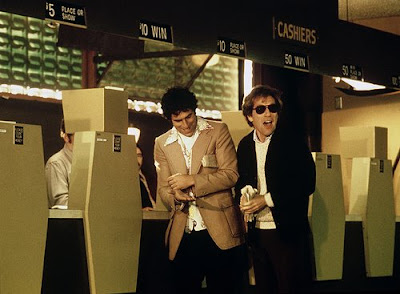 Charlie (Elliot Gould) and Bill (George Segal) meet among accusations of cheating in a chaotic LA cardroom and bond over drinks, silly prop bets, and a mugging. Bill--an actual, productive member of society and only a casual gambler--is both fascinated and horrified by Charlie's life, with his call-girl roommates, petty ripoffs, and morning beer. Soon of course he's hiding from his boss, joining Charlie at the track, and getting in bad with his bookie. Two things really carry this movie through its desultory plot: First is Gould's great Altman chemistry--he owns the screen as a colorful, slightly menacing whirlwind, playing a character that is apparently about 80% Gould. Second is the sense of euphoric claustrophobia: Altman accomplishes this in part through his blanket of dialogue (in eight-track stereo!), which captures the non-stop and even oppressive hubbub of casinos and similar places; but he also puts together some great shots (Bill, giddy as if he's calling a new crush, gets off the phone with Charlie and gets a little tangled in the cord; Bill and one of the girls try to get undressed on a couch), where excitement, cramped quarters, and slightly oppressive close-ups combine into a great representation of the discomfort and thrill of out-of-control gambling.
Eventually, Bill is in deep enough that he gives it all over to a hunch: he has a "special feeling" and hocks all his possessions, and he and Charlie head to Reno for a high-stakes poker game. Bill goes on a heater and crushes the game (including Amarillo Slim); he takes his winnings to blackjack and roulette and craps; and we find ourselves watching the fable and wondering how it will crash down around them. A comedy (less for its laughs than its temperament) about the absurdity and pathos of gamblers becomes, in a matter of seconds, an understated, tense meditation on chance, expectation, and superstition.
This is a neat film to remind you what you like about "major" Altman--the bemused horror at Americana, the crush of people and lives, the setting as character. It is also a good film to remind you about the difference between confidence and luck, and the dangers of confusing the two.
[Photo: Egyptian Femme! EGYPTIAN FEMME!]
 Charlie (Elliot Gould) and Bill (George Segal) meet among accusations of cheating in a chaotic LA cardroom and bond over drinks, silly prop bets, and a mugging. Bill--an actual, productive member of society and only a casual gambler--is both fascinated and horrified by Charlie's life, with his call-girl roommates, petty ripoffs, and morning beer. Soon of course he's hiding from his boss, joining Charlie at the track, and getting in bad with his bookie. Two things really carry this movie through its desultory plot: First is Gould's great Altman chemistry--he owns the screen as a colorful, slightly menacing whirlwind, playing a character that is apparently about 80% Gould. Second is the sense of euphoric claustrophobia: Altman accomplishes this in part through his blanket of dialogue (in eight-track stereo!), which captures the non-stop and even oppressive hubbub of casinos and similar places; but he also puts together some great shots (Bill, giddy as if he's calling a new crush, gets off the phone with Charlie and gets a little tangled in the cord; Bill and one of the girls try to get undressed on a couch), where excitement, cramped quarters, and slightly oppressive close-ups combine into a great representation of the discomfort and thrill of out-of-control gambling.
Eventually, Bill is in deep enough that he gives it all over to a hunch: he has a "special feeling" and hocks all his possessions, and he and Charlie head to Reno for a high-stakes poker game. Bill goes on a heater and crushes the game (including Amarillo Slim); he takes his winnings to blackjack and roulette and craps; and we find ourselves watching the fable and wondering how it will crash down around them. A comedy (less for its laughs than its temperament) about the absurdity and pathos of gamblers becomes, in a matter of seconds, an understated, tense meditation on chance, expectation, and superstition.
This is a neat film to remind you what you like about "major" Altman--the bemused horror at Americana, the crush of people and lives, the setting as character. It is also a good film to remind you about the difference between confidence and luck, and the dangers of confusing the two.
[Photo: Egyptian Femme! EGYPTIAN FEMME!]
Wednesday, November 19, 2008
I will see Labor Pains, no matter what you say
So Lindsay Lohan's been in the news again. I'm not here to defend her choice of words, which though odd was probably not racist in any traditional sense. I'm here to defend my fondness for her, which has not died despite her terrible behavior and her even worse movies.
First, let's take a minute to remember her charming and delightful early days.
Behold the precociousness of her in the remake of The Parent Trap:
That uppercrusty English accent is totally recognizable!
Really good child actors with few exceptions (Jodie Foster, um...I can't think of any other exceptions...Scott Baio? Dean Stockwell, I guess) grow up to be...really good child actors. Think of Macaulay Culkin in Party Monster. He is perfect in the role, but only because he is a terrible over-actor playing a terrible over-actor. Christina Ricci has carved out a fairly respectable carreer almost entirely made of camp. But speaking of Jodie Foster, the first thing I remember seeing Lindsay in was the remake of Freaky Friday, in which she plays a Rebellious Teenager (or the Disney version of one). Freaky Friday isn't an important movie, and it does nothing new, but it is exactly what it sets out to be: cute, fun, competent, predictable. This is what I want from a PG/PG-13 teen comedy.
Which brings me to Mean Girls, a movie that slightly exceeds expectations on almost every scale. It's smarter than it should be. The cast is better than it looks. The jokes are funnier than you would expect -- people often point out that Tina Fey, who wrote the screenplay, was the first woman head writer on Saturday Night Live, which is probably true, but she was the head writer during one of the show's least funny eras. And yet.
I was dragged to Mean Girls (by Anna, who is my reliable date for lame movies, from Uptown Girls to Mamma Mia. So far). Before it left the theater, I had seen it two more times. Lindsay Lohan plays Cady, a high school junior transplanted from Africa, where she was home schooled, to a public school in suburban Evanston, Illinois. She is befriended by "art freaks" Damien and Janis Ian (hm), then betrays them on a climb up the social ladder of high school. Sounds like a boring cliche, and it is a cliche, but the script is so neatly crafted, the characters just three-dimensional enough, that the movie overall succeeds where it could very easily have failed. Mean Girls isn't flawless (it could be a little less homophobic, for one, and after repeated viewings the "Asian hotties" are truly cringe-worthy) but it's close.
LL starred in a few other fine-but-forgettable teen movies (Confessions of a Teenage Drama Queen, Herbie the Love Bug). And she was in I Know Who Killed Me, a movie almost but not quite absurd and unsatisfying enough to be entertaining as an example of How Not to Make A Movie. Then there was Georgia Rule. Garry Marshall has directed a fair number of my least favorite movies, but Georgia Rule is in a category of its own. It feels like it was written for the Lifetime network, but it's rated R. It is sappy yet brutal, naive yet loveless. I really really hated it.
Still, on the strength of my Mean Girls affection, I decided to give Just My Luck a chance when I noticed it in the grocery store DVD rental box, and I thought it was fine. It was cute and fun and competent and predictable, just like I wanted it to be. And she was in Robert Altman's last movie, A Prairie Home Companion. For me, the PHC movie was just like the radio show - awesome when it's people performing songs and kinda pointless otherwise.
Anyway, I guess I would just like Lindsay Lohan to ignore Roger Ebert's advice that she "move on to more challenging roles." It seems clear that she can neither choose nor carry a heavy movie. But that's okay! We need more charming fun predictable character actors, and she can totally do that.
Oh, one more thing. Kristin provided the only plausible explanation of the weird line in LL's Access Hollywood interview. Turns out, she never said "our first colored president." Turns out, she said "our first unicorn president." Go watch it again. Now. She totally says unicorn. UNICORN.
First, let's take a minute to remember her charming and delightful early days.
Behold the precociousness of her in the remake of The Parent Trap:
That uppercrusty English accent is totally recognizable!
Really good child actors with few exceptions (Jodie Foster, um...I can't think of any other exceptions...Scott Baio? Dean Stockwell, I guess) grow up to be...really good child actors. Think of Macaulay Culkin in Party Monster. He is perfect in the role, but only because he is a terrible over-actor playing a terrible over-actor. Christina Ricci has carved out a fairly respectable carreer almost entirely made of camp. But speaking of Jodie Foster, the first thing I remember seeing Lindsay in was the remake of Freaky Friday, in which she plays a Rebellious Teenager (or the Disney version of one). Freaky Friday isn't an important movie, and it does nothing new, but it is exactly what it sets out to be: cute, fun, competent, predictable. This is what I want from a PG/PG-13 teen comedy.
Which brings me to Mean Girls, a movie that slightly exceeds expectations on almost every scale. It's smarter than it should be. The cast is better than it looks. The jokes are funnier than you would expect -- people often point out that Tina Fey, who wrote the screenplay, was the first woman head writer on Saturday Night Live, which is probably true, but she was the head writer during one of the show's least funny eras. And yet.
I was dragged to Mean Girls (by Anna, who is my reliable date for lame movies, from Uptown Girls to Mamma Mia. So far). Before it left the theater, I had seen it two more times. Lindsay Lohan plays Cady, a high school junior transplanted from Africa, where she was home schooled, to a public school in suburban Evanston, Illinois. She is befriended by "art freaks" Damien and Janis Ian (hm), then betrays them on a climb up the social ladder of high school. Sounds like a boring cliche, and it is a cliche, but the script is so neatly crafted, the characters just three-dimensional enough, that the movie overall succeeds where it could very easily have failed. Mean Girls isn't flawless (it could be a little less homophobic, for one, and after repeated viewings the "Asian hotties" are truly cringe-worthy) but it's close.
LL starred in a few other fine-but-forgettable teen movies (Confessions of a Teenage Drama Queen, Herbie the Love Bug). And she was in I Know Who Killed Me, a movie almost but not quite absurd and unsatisfying enough to be entertaining as an example of How Not to Make A Movie. Then there was Georgia Rule. Garry Marshall has directed a fair number of my least favorite movies, but Georgia Rule is in a category of its own. It feels like it was written for the Lifetime network, but it's rated R. It is sappy yet brutal, naive yet loveless. I really really hated it.
Still, on the strength of my Mean Girls affection, I decided to give Just My Luck a chance when I noticed it in the grocery store DVD rental box, and I thought it was fine. It was cute and fun and competent and predictable, just like I wanted it to be. And she was in Robert Altman's last movie, A Prairie Home Companion. For me, the PHC movie was just like the radio show - awesome when it's people performing songs and kinda pointless otherwise.
Anyway, I guess I would just like Lindsay Lohan to ignore Roger Ebert's advice that she "move on to more challenging roles." It seems clear that she can neither choose nor carry a heavy movie. But that's okay! We need more charming fun predictable character actors, and she can totally do that.
Oh, one more thing. Kristin provided the only plausible explanation of the weird line in LL's Access Hollywood interview. Turns out, she never said "our first colored president." Turns out, she said "our first unicorn president." Go watch it again. Now. She totally says unicorn. UNICORN.
Friday, October 31, 2008
Non-horror non-review: Black Orpheus (1959)

Marpessa Dawn and Breno Mello both passed away this year, which is too bad, but does provide an opening to bring up the one big film of their lives. ("Bring up," not "review," 'cause I spent two days not being able to find my copy in a garage full of boxes and being too cheap to rent something I already own; so I didn't get to rewatch it, but what the hell I love this movie anyway, and at least that means I'll keep this mercifully short.)
Black Orpheus is not horror, but it is a fable about our greatest fears (death and loss). And actually the film sort of divides neatly into two different horrorish films. The first features Death (in a fantastic skeleton/spiderweb/luchador costume) stalking Eurydice during Carnaval: Death is persistent and (despite costume-switching) not easy to fool; the scene where Death pursues Eurydice during the samba competition, and Orfeu chases both of them to the trolley station, is both suspenseful and garishly outsize, all Hitchcock pacing and Fellini visuals. The second, after Eurydice's death, is about the disorientation, the existential confusion of loss: Orfeu first attempts to find the dead Eurydice at the Bureau of Missing Persons; the Tiresias-like (he's blind, maybe? there's someone blind in this film...) janitor tells him where he can find his love--through a medium in a candomblé ceremony. 'Cause she's dead, right? From here, it's the great tragedy of the fable--Orfeu is not only unable to bring Eurydice back, he is even incapable of not causing her loss again.

The movement from natural suspense (someone stalking Eurydice) to supernatural terror (freakin' Death stalking Eurydice) to existential horror (you and everyone you have ever loved will die) is basically all the horror content Black Orpheus offers, but that's quite enough. Not to mention the wonderful songs, bold colors, classical allusions, and the most achingly sweet scene of children dancing that ever closed a movie.
Tuesday, October 28, 2008
When a Stranger Calls (1979)
 "Why did someone make two movies, then make a movie sandwich?" -Kristin
We watched When a Stranger Calls last week. It starts Carol Kane (I had no idea when I rented it -- also, this movie was, in 1979, her fourteenth movie, says imdb. She was in Dog Day Afternoon? And Annie Hall? I guess I don't remember either of those movies as well as I think I do). Anyway, I liked When a Stranger Calls. It's always fun to see a familiar actress in a surprising role, and even without Carol Kane, it would have been an average tense scary movie.
Carol Kane is Jill, a young babysitter who receives harassing phone calls. She calls the police, who do not seem concerned and at any rate can do nothing unless she can keep the stranger on the phone while they trace the call. When they do trace the call, it is coming from...inside the house! Up to this point, the pace of the film has been slow, but now things happen fast: a shadowy figure at the top of the stairs, then the police are at the door, the children have been brutally slain in their beds, and the killer is arrested.
Years later, Jill is happily married with two adorable children of her own. Two way too adorable children, by the way: "Mommy, come closer. I have to tell you something." "What is it?" "I love you." We watch Jill act out domestic bliss, putting her children to bed, calling a babysitter for the evening. Meanwhile, the killer has escaped from a mental hospital, and he's up to his old tricks. Perhaps having lived through the trauma of finding you sat quietly downstairs while two children in your care were murdered in their beds would give you pause before leaving your own children with anyone, ever, but rational realistic behavior is not the point of a movie like When a Stranger Calls. The point of a movie like this one is to experiment with pacing and building tension. Well, that and laughing at this dude's hair. I'd say the movie is well worth seeing, except for that one thing...
Unfortunately, When a Stranger Calls is only about 4o minutes long. And in the middle of it, inexplicably, there is another, much more boring movie, comprising scene after scene of Colleen Dewhurst looking sort of washed up and slutty (yes, that Colleen Dewhurst) while walking fast down dark streets in heels. Charles Durning makes a valiant effort to weave the two stories together, but it is at best a tenuous connection.
p.s. Does anyone recognize the waiter at 0:22 - 0:26 in the clip above? Just curious.
Thursday, October 23, 2008
Rear Window (1954)
 "We're two of the most frightening ghouls I've ever known."
 While this is probably the most technically beautiful movie I can remember seeing, to talk at length about Hitchcock’s camerawork would be like going to the Antarctic and reporting on how very, very cold it was. If you’ve been there you know and it can obscure its subtler features, like the native subcutaneous parasites. For the sake of everyone’s hypothalamus gland, this would be a mistake.
By confining us to Stewart’s perspective, Rear Window does not only implicate us in his voyeurism, it also invests us in its world. Loneliness and isolation are as major a part of the feel of the film as the guilty delight in watching, especially since its sounds are mostly ambient. It is not until the dog is killed that the leads act on the plot directly, meaning it is the killer who first breaks the neighborhood’s silent taboo. While the broach of privacy isn’t portrayed as less moral than the wife’s murder, it is the one that provokes an interaction. Compare the dog-owner’s denouncement of her neighbor’s indifference to Mrs. Thorwald’s scream the night of the murder. Every window turns to hear the dog-speech, but even our hero, who is watching the Thorwalds when the scream happens, responds by falling asleep.
Situated in this narrative world, Stewart and Kelly’s relationship is what I find most interesting. Even before anything is afoot, we witness Stewart’s neuroses over his “too perfect” relationship. The film’s discomfort with intimacy seems to stand in as their real problem, especially since Stewart’s version of the problem is inconsistent (he tells his nurse she’s too good while telling Kelly they’re too different). She’s a career-minded socialite; he’s a free-spirited adventurer who can’t be tied down; these would be the hallmarks of romance if they weren’t presented by complete absence. Unlike how a romantic comedy tends to show characters struggling to find a balance between their public and private lives, Rear Window ignores the public side and obsesses with the private while its lead characters begin the film by doing just the reverse. The mean, weird indifference of love is overcome by their engagement in the plot. If the two have nothing else in common they’ve found someone to share their perverse fascinations, which is, I think, as good a definition of happiness as any.
Stewart’s confrontation with Thorwald is remarkable, and Halloween-appropriate. While the film tends to confront the morality of voyeurism by having the characters flatly ask each other about it, this scene is probably the most useful to the discussion. It has signifiers of horror- the heavy steps up the stairs, Throwald’s now-obscured and surprisingly large figure looming in the doorway. While the terror of the scene is mostly based on our identification with Stewart’s character, Thorwald’s reaction is interesting. Upon entering to find a seated silhouette of a man Thorwald says, “Say something… anything,” before advancing. We are offered only the slightest glimpse of the murder’s terror: confronting a faceless man after days of being privately observed, to all appearances calm enough to stay in his chair when a murderer breaks into his door. A reversal made all the more chilling by its transience.
By confining us to Stewart’s perspective, Rear Window does not only implicate us in his voyeurism, it also invests us in its world. Loneliness and isolation are as major a part of the feel of the film as the guilty delight in watching, especially since its sounds are mostly ambient. It is not until the dog is killed that the leads act on the plot directly, meaning it is the killer who first breaks the neighborhood’s silent taboo. While the broach of privacy isn’t portrayed as less moral than the wife’s murder, it is the one that provokes an interaction. Compare the dog-owner’s denouncement of her neighbor’s indifference to Mrs. Thorwald’s scream the night of the murder. Every window turns to hear the dog-speech, but even our hero, who is watching the Thorwalds when the scream happens, responds by falling asleep.
Situated in this narrative world, Stewart and Kelly’s relationship is what I find most interesting. Even before anything is afoot, we witness Stewart’s neuroses over his “too perfect” relationship. The film’s discomfort with intimacy seems to stand in as their real problem, especially since Stewart’s version of the problem is inconsistent (he tells his nurse she’s too good while telling Kelly they’re too different). She’s a career-minded socialite; he’s a free-spirited adventurer who can’t be tied down; these would be the hallmarks of romance if they weren’t presented by complete absence. Unlike how a romantic comedy tends to show characters struggling to find a balance between their public and private lives, Rear Window ignores the public side and obsesses with the private while its lead characters begin the film by doing just the reverse. The mean, weird indifference of love is overcome by their engagement in the plot. If the two have nothing else in common they’ve found someone to share their perverse fascinations, which is, I think, as good a definition of happiness as any.
Stewart’s confrontation with Thorwald is remarkable, and Halloween-appropriate. While the film tends to confront the morality of voyeurism by having the characters flatly ask each other about it, this scene is probably the most useful to the discussion. It has signifiers of horror- the heavy steps up the stairs, Throwald’s now-obscured and surprisingly large figure looming in the doorway. While the terror of the scene is mostly based on our identification with Stewart’s character, Thorwald’s reaction is interesting. Upon entering to find a seated silhouette of a man Thorwald says, “Say something… anything,” before advancing. We are offered only the slightest glimpse of the murder’s terror: confronting a faceless man after days of being privately observed, to all appearances calm enough to stay in his chair when a murderer breaks into his door. A reversal made all the more chilling by its transience.
Sunday, October 19, 2008
There's always room for giallo
The Psychic, 1977
(a.k.a. Sette Note in Nero, Murder to the Tune of the Seven Black Notes)
dir. Lucio Fulci
I am no expert on Italian horror. I really love Phenomenon and some other Dario Argento movies, and I’ve seen a few of Lucio Fulci’s movies (including Zombie at least three or four times). But I don’t really have a sense of what to expect from Fulci, except these things: terrible special effects, weird inappropriate sexual content, interesting new kinds of gore, and characters who behave in ways that make no sense at all (the classic example of this last being the delightful shit-I-forgot-to-shoot-fritz-in-the-head plot of Zombie). When I rented The Psychic, I thought I would enjoy it for occasional surprise kills and an entertaining absence of logic or plot, but apart from some decapitations or falls-from-a-great-height or maggot-infested corpses, I thought I would be…well, kinda bored. I did not think I would genuinely enjoy the visual aspects of the film. I was pleasantly surprised. The utterly unsubtle use of color, especially red (another alternate title could be The Red Lampshade) puts this movie in a category—with Suspiria—of just plain beautiful movies.
Lisa and the Devil, 1973
(a.k.a. La Casa dell'esorcismo, The House of Exorcism)
dir. Mario Bava
(n.b. I was confused by Lisa and the Devil, and I didn't follow every minute of the plot, but I'm pretty sure there is no exorcism in this movie.)
I have no idea what this movie is about.

The eyes, Leandro, what color are the eyes?
Changeable my lady. But by candlelight they are blue.
Lisa is an American tourist. She sees a weird fresco of the devil, carrying a body of some kind, and looking a lot like Kojak. Then she gets lost in the narrow streets and alleys of Some Foreign City, meets Telly Savalis, and gets creeped out. Somehow, she ends up staying in an ancient house where Telly Savalis is, um, what, the butler? I guess? I’ll admit I probably did not pay as much attention as this movie requires. It seemed like every time I looked away from the screen for a minute, then looked back, a pair of completely new characters are making out in a different location, then the camera focuses on a statue nearby. Eventually, the blind matriarch of the strange ancient house reveals what everyone (except the audience) has been thinking: Lisa is the reincarnation of the dead bride of the blind woman’s creepy son.* Therefore, the son must chloroform Lisa, and have sex with her in the bed where he still keeps the skeletal remains of Elena, his first bride. Obviously.
Lisa and the Devil is surreal and confusing, but in a good way. The cast, especially Telly Savalis (looks like the devil, is the devil, eats many lollipops, sings about flowers), give memorable performances, and I found the final scene genuinely creepy and interesting.
Let’s just say this: Lisa and the Devil is my favorite movie about necrophilia and lollipops.
*It might be overstating it to say that Psycho invented the modern horror movie, but seriously what percentage of the last half-century of scary movies have not been about nutty sons and their overbearing mothers? Ten percent? Twenty? (Alien, Friday the 13th, Dead Alive are the first three that spring to mind…)
(a.k.a. Sette Note in Nero, Murder to the Tune of the Seven Black Notes)
dir. Lucio Fulci
I am no expert on Italian horror. I really love Phenomenon and some other Dario Argento movies, and I’ve seen a few of Lucio Fulci’s movies (including Zombie at least three or four times). But I don’t really have a sense of what to expect from Fulci, except these things: terrible special effects, weird inappropriate sexual content, interesting new kinds of gore, and characters who behave in ways that make no sense at all (the classic example of this last being the delightful shit-I-forgot-to-shoot-fritz-in-the-head plot of Zombie). When I rented The Psychic, I thought I would enjoy it for occasional surprise kills and an entertaining absence of logic or plot, but apart from some decapitations or falls-from-a-great-height or maggot-infested corpses, I thought I would be…well, kinda bored. I did not think I would genuinely enjoy the visual aspects of the film. I was pleasantly surprised. The utterly unsubtle use of color, especially red (another alternate title could be The Red Lampshade) puts this movie in a category—with Suspiria—of just plain beautiful movies.
Lisa and the Devil, 1973
(a.k.a. La Casa dell'esorcismo, The House of Exorcism)
dir. Mario Bava
(n.b. I was confused by Lisa and the Devil, and I didn't follow every minute of the plot, but I'm pretty sure there is no exorcism in this movie.)
I have no idea what this movie is about.
The eyes, Leandro, what color are the eyes?
Changeable my lady. But by candlelight they are blue.
Lisa is an American tourist. She sees a weird fresco of the devil, carrying a body of some kind, and looking a lot like Kojak. Then she gets lost in the narrow streets and alleys of Some Foreign City, meets Telly Savalis, and gets creeped out. Somehow, she ends up staying in an ancient house where Telly Savalis is, um, what, the butler? I guess? I’ll admit I probably did not pay as much attention as this movie requires. It seemed like every time I looked away from the screen for a minute, then looked back, a pair of completely new characters are making out in a different location, then the camera focuses on a statue nearby. Eventually, the blind matriarch of the strange ancient house reveals what everyone (except the audience) has been thinking: Lisa is the reincarnation of the dead bride of the blind woman’s creepy son.* Therefore, the son must chloroform Lisa, and have sex with her in the bed where he still keeps the skeletal remains of Elena, his first bride. Obviously.
Lisa and the Devil is surreal and confusing, but in a good way. The cast, especially Telly Savalis (looks like the devil, is the devil, eats many lollipops, sings about flowers), give memorable performances, and I found the final scene genuinely creepy and interesting.
Let’s just say this: Lisa and the Devil is my favorite movie about necrophilia and lollipops.
*It might be overstating it to say that Psycho invented the modern horror movie, but seriously what percentage of the last half-century of scary movies have not been about nutty sons and their overbearing mothers? Ten percent? Twenty? (Alien, Friday the 13th, Dead Alive are the first three that spring to mind…)
Friday, October 17, 2008
well calculated to keep you in SUSPENSE
 Yesterday at work I listened to an episode of the long-running CBS radio show Suspense: "Consequence" starring James Stewart. "Consequence" originally aired on September 13th, 1945. Nothing makes me feel comfortable and nostalgic and dreamy like Jimmy Stewart's voice on a scratchy record. (When I was young, I had a recording of him reading Winnie the Pooh stories, and he always inspires feelings of calm and nostalgia.) What "Consequence" reminded me of though is what a genuinely really strong actor he was. When he says, "Of course she killed her. We both killed her" he sounds broken and heartbreaking.
Why you should listen to Suspense:
1. Some of the movies we know and love either started there ("Sorry Wrong Number") or were remade there ("The Lodger"). The popular "Sorry, Wrong Number" is better as a radio story. Agnes Moorehead's portrayal of claustrophobia and desperate aloneness is so real when you only hear her voice, in a story of a bedridden woman desperately seeking help with only the telephone for contact with the outside world.
2. Suspense will inform your experience of more contemporary horror. What television and DVDs are to to us now, these stories were in the 40s.
3. TONS of awesome movie stars. Frank Sinatra's first dramatic role was on Suspense. Off the top of my head: Joseph Cotton, Henry Fonda, Orson Welles, James Steward, Agnes Moorehead.
http://www.archive.org/details/SUSPENSE
I listen to the "Suspense Replay" podcast:
Thursday, October 16, 2008
Tora! Tora! Tora!
Depsite its reputation as notoriously dull, Tora! Tora! Tora! (1970) is a fascinating movie, with one of the most interesting leads ever seen shot on film. The lead, naturally, is the Japanese military, portrayed at the very height of its strength in 1941. The primary events in the story surround the attack on Pearl Harbor, and as such it is, I suppose, a historical movie. Indeed, it is obsessed with factual accuracy, and, by and large, achieves it. The narrative, however, is a classical tragedy, of which we see merely the climax. In T!T!T!, the protagonist (let’s call him J.M) is portrayed as powerful, agile, and youthful, full of energy and ambition. However, unsurprisingly, J.M. is also filled with a youthful arrogance and, if I may, hubris. Perhaps worse, J.M. combines this arrogance with a deep suspicion and fear of his social betters, which derives (though this outside the narrative scope of T!T!T!) from his childhood reputation as both stupid and weak. Bullied through his childhood, now that J.M. has come into his own, he fears a recurrence, and forms an extremely clever plan to stop it.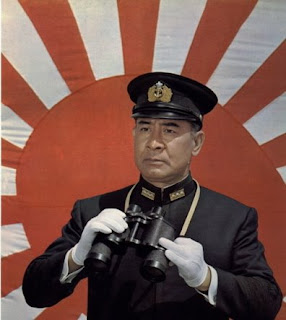 However, due in part to unfortunate circumstance, but primarily to the fact that J.M.’s plan was too intricate to really work, J.M.’s plan misfires, and ends by instigating precisely the aggression that J.M. so feared. The final lines of the movie portray both its tone and institutional focus, when Admiral Yamamoto, the leader of the attack, says, “I fear all we have done is to awaken a sleeping giant and fill him with a terrible resolve.” The actual statement on which this line is probably based is even more humanizing, attributing to the United States as a corporate entity actual emotions and actions: “A military man can scarcely pride himself on having 'smitten a sleeping enemy'; it is more a matter of shame, simply, for the one smitten. I would rather you made your appraisal after seeing what the enemy does, since it is certain that, angered and outraged, he will soon launch a determined counterattack.”
It is not easy to portray the intricacies of an institution personality in film, and we should not therefore be surprised that many people, mistaking the people in the film for the primary characters, find the action dull and the interactions unmoving. This is much like arguing that Macbeth is boring, because the relationship between his liver and his large intestine is never really explored. The real characters here are national institutions, and it is their characters, their strengths and weaknesses, their hopes and fears, and not those of any of the individuals that compose them, that matter in T!T!T!. Seen from this perspective, T!T!T! is a compelling and fascinating character drama, and the very climax of a tragedy. Although attempts to portray aggregate characters are quite rare, they had something of a golden age in the late sixties through early seventies. The Andromeda Strain (1971) is an excellent example, and Dr. Strangelove (1964) and 2001 (1968) both contain elements of the genre.
Depsite its reputation as notoriously dull, Tora! Tora! Tora! (1970) is a fascinating movie, with one of the most interesting leads ever seen shot on film. The lead, naturally, is the Japanese military, portrayed at the very height of its strength in 1941. The primary events in the story surround the attack on Pearl Harbor, and as such it is, I suppose, a historical movie. Indeed, it is obsessed with factual accuracy, and, by and large, achieves it. The narrative, however, is a classical tragedy, of which we see merely the climax. In T!T!T!, the protagonist (let’s call him J.M) is portrayed as powerful, agile, and youthful, full of energy and ambition. However, unsurprisingly, J.M. is also filled with a youthful arrogance and, if I may, hubris. Perhaps worse, J.M. combines this arrogance with a deep suspicion and fear of his social betters, which derives (though this outside the narrative scope of T!T!T!) from his childhood reputation as both stupid and weak. Bullied through his childhood, now that J.M. has come into his own, he fears a recurrence, and forms an extremely clever plan to stop it.
 However, due in part to unfortunate circumstance, but primarily to the fact that J.M.’s plan was too intricate to really work, J.M.’s plan misfires, and ends by instigating precisely the aggression that J.M. so feared. The final lines of the movie portray both its tone and institutional focus, when Admiral Yamamoto, the leader of the attack, says, “I fear all we have done is to awaken a sleeping giant and fill him with a terrible resolve.” The actual statement on which this line is probably based is even more humanizing, attributing to the United States as a corporate entity actual emotions and actions: “A military man can scarcely pride himself on having 'smitten a sleeping enemy'; it is more a matter of shame, simply, for the one smitten. I would rather you made your appraisal after seeing what the enemy does, since it is certain that, angered and outraged, he will soon launch a determined counterattack.”
It is not easy to portray the intricacies of an institution personality in film, and we should not therefore be surprised that many people, mistaking the people in the film for the primary characters, find the action dull and the interactions unmoving. This is much like arguing that Macbeth is boring, because the relationship between his liver and his large intestine is never really explored. The real characters here are national institutions, and it is their characters, their strengths and weaknesses, their hopes and fears, and not those of any of the individuals that compose them, that matter in T!T!T!. Seen from this perspective, T!T!T! is a compelling and fascinating character drama, and the very climax of a tragedy. Although attempts to portray aggregate characters are quite rare, they had something of a golden age in the late sixties through early seventies. The Andromeda Strain (1971) is an excellent example, and Dr. Strangelove (1964) and 2001 (1968) both contain elements of the genre.
Tuesday, October 14, 2008
Monster Man
 I don't want to talk about it.
Even for a film of a genre with an expectation of the unthinkable, Monster Man is quite shocking. Billed as a “horror-comedy by the writer-director of 100 Girls,” the film tells the story of a man driving to his ex-girlfriend’s wedding while his friend repeatedly calls him a wussy. Along the way the pair is beset by the typical horrors of rural America (roadkill in the bed, decapitated Winnebago driver, etc.) which are a welcome reprieve from Justin Ulrich’s incomprehensible single-entendres. Along the way the pair gropes, then picks up an allegedly stunning hitchhiker, and the three respond to these occult happenings the in the only sensible way: brutally insulting everyone they meet at gas stations. This contempt for Midwesterners even appears in the characters’ private moments: as Aimee Brooks retorts while splayed out in front of some Nascar in the motel, “These fucking rednecks must have IQs the same number as the size of my underwear to watch this!” Really, if you’re going to be pretentious about how much hotter you are than someone’s intellect, at least have some syntax about it. At some point they are pursued by a big truck and find some body parts in their food, but no visceral or automotive horror can approach the film’s real monster: the ten minutes of Yoda-themed sex that would have Kevin Smith saying, “These people overlook the subtly of my work.”
Not only do Monster Man’s jabs at edginess create a hostile circle of dislikable heroes, they detract from what should be its greatest strength. In putting on such a front of cool, the film denies itself the kind of camp that makes the worst horror so wonderfully indulgent. It is, at least, a unique kind of bad, to be watched only by the deeply masochistic. Really only two things can be said about this movie: it must be seen to be believed, and it must never be seen.
Young Frankenstein
Why is Young Frankenstein better than everything else Mel Brooks has ever done combined? Usually in cases like this (the case of the single exception) I might make an argument that the exception is nothing like the rule. But Young Frankenstein is absolutely a Mel Brooks movie: sexist, derivative, offensive, and full of scatological humor. Statistically, the cast might be slightly more talented overall, but plenty of solid comic actors have slummed in Brooks's bad movies. Hell, Madeline Kahn is hilarious, and she's in practically every one of his goddamn movies.
Young Frankenstein should not be funny to me. Take the whole Monster's Big Fat Dick plot. A story so bizarrely and willfully naive about female sexual desire should make me feel puzzled and not at all entertained. But when Madeline Kahn starts singing, I snort appreciatively. Gene Hackman's cameo is an even better example. It is the worst, cheapest kind of humor. There is nothing clever about the idea of a blind man who is incapable of telling the difference between ladling soup into a bowl and ladling it into your lap. And while this series of jokes doesn't make me laugh (nor even snort appreciatively), it doesn't quite piss me off enough to stop me smiling at "I was going to make espresso." Or marveling at what Peter Boyle does with his eyes.
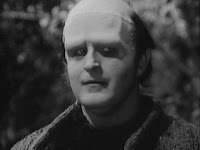 Peter Boyle was a genius. Without a single line of real dialogue in the first 90% of the movie, Boyle is the funniest part of the movie. His first line ("mmmMMMMMM") might be the best scene. Actually, my favorite moment is when he's playing with a little girl, throwing flower petals in a well until all the petals are gone. "What can we throw now?" says the girl naively. And the monster just looks at us. (Interestingly, imdb confirms that Young Frankenstein is the only project on which Boyle and Brooks are credited together. Perhaps Peter Boyle is the key to Mel Brooks not sucking?)
Young Frankenstein should not be funny to me. Take the whole Monster's Big Fat Dick plot. A story so bizarrely and willfully naive about female sexual desire should make me feel puzzled and not at all entertained. But when Madeline Kahn starts singing, I snort appreciatively. Gene Hackman's cameo is an even better example. It is the worst, cheapest kind of humor. There is nothing clever about the idea of a blind man who is incapable of telling the difference between ladling soup into a bowl and ladling it into your lap. And while this series of jokes doesn't make me laugh (nor even snort appreciatively), it doesn't quite piss me off enough to stop me smiling at "I was going to make espresso." Or marveling at what Peter Boyle does with his eyes.
 Peter Boyle was a genius. Without a single line of real dialogue in the first 90% of the movie, Boyle is the funniest part of the movie. His first line ("mmmMMMMMM") might be the best scene. Actually, my favorite moment is when he's playing with a little girl, throwing flower petals in a well until all the petals are gone. "What can we throw now?" says the girl naively. And the monster just looks at us. (Interestingly, imdb confirms that Young Frankenstein is the only project on which Boyle and Brooks are credited together. Perhaps Peter Boyle is the key to Mel Brooks not sucking?)
Monday, October 13, 2008
Cloverfield
"Something else. Also terrible."
There is something odd about a monster movie that isn't about the monster. The brief but evocative hints at backstory indicate doom for our protagonists but ultimately a human victory, with an aftermath where survivors attempt to catalog and categorize the events*. Yet when we try to put it all together, these efforts don't quite obtain: how did a tape survive the carpetbombing of Manhattan? how does this victory jibe with the spooky backmasked "It's still alive"? "Cloverfield" makes little sense as the name of the monster itself (as the title card's "sightings of case designate" seems to indicate) or the name of the case file (to today's literal-minded military); as yet a third name for US-447/Central Park it is powerful and allusive, but chronologically impossible. We are successfully kept off-balance by these hints--we know far more than the characters but far less than the people preserving and presenting this record of events.
The movie famously opens with mundane recording of the lives of beautiful young people, mostly a going-away party featuring soapy recrimination and the cameraman's embarassing crush on Lizzy Caplan. Only after 20 minutes does an explosion remind us that a monster is coming to eat everyone. After a brief feint toward satire, as American voyeur society quickly realizes that a cell phone camera won't stop a Cthulhoid horror, the movie uses the simplest of plots (1. Find way off the island 2. Rescue pseudo-girlfriend) to set up some decent set pieces and action sequences and some good scenes of people freaking right the fuck out: a few scary bits (night-vision view in the subway tunnel), gory bits (Caplan EXPLODING, awesome), sudden surprises (monster got some Spud Webb vertical leap); standard stuff, serviceably executed.
The most terrifying part, though, is our heroes navigating the roof of a half-collapsed apartment building with no monster in sight. But Cloverfield doesn't feel like a monster movie with a motivated, personalized, allegorical** villain anyway; it's a disaster movie with an impersonal, implacable force of nature. Between the no-name cast and annoying camera work, I feared this would be a reworking of the worst parts of Blair Witch Project; I was pleasantly surprised.
*Abrams has also offloaded much of the narrative to a viral marketing campaign à la LOST. It expands the story into strange doings around the underwater-drilling, satellite-launching Japanese corporate concern Tagruato, involving their popular beverage Slusho! and its sea-mined secret ingredients (shades of Brawndo and Slurm). Yeah, I know; but at least he avoids smoke monsters, time travel, and jungle polar bears this time. So far.
**So, so relieved that the destruction of Lower Manhattan wasn't about terrorism like Godzilla was "about" nuclear blah blah blah. So relieved.
Sunday, October 12, 2008
Planet Earth: Jungles
 Technically the seventh in a series, Planet Earth: Jungles begins in the tradition of its documentary-style predecessors. Thusly guised, it begins with a humble sample of the characters populating this world, and we the viewers are hard pressed not to identify with them: the spider monkey, engaged in the interminable rat-race for figs; the bird of paradise, for whom sexuality is an exhausting display. But even the most lighthearted moments are permeated by reminders that this is the world’s largest population and it is vulnerable. As David Attenborough narrates with an uneasy calm, the lower level of the forest is starved of sunlight. It is here, in the lightless gnarl, that we are given something to fear.
We are abruptly cut to a lamentable everyman: a red jungle ant in the final stages of a peculiar madness. Borne away from the colony by its former workmates (their faces tiny, humorless masks of grim resignation), the camera stays on the body through its death and the following weeks- it is here that we meet our monster. The cordyceps fungus buds gradually from the miserable once-ant, as though testing the air of this new reality. Not since the Alien series has the monstrous been so eerily merged with sexual imagery. The fungus is a quivering phallus, penetrating from its now-hollow host the world outside it. In the scenes that follow, the creature’s cousins demonstrate their horrible works: lush panoramas of shapeless colour, spilling from the shells of their insect bearers. It would be Lovecraftian if those abominations didn’t at least have the decency to bear orientable features like tentacles and wings. While I was too frightened to complete the film, it is natural to assume the parasite spreads across the planet and ultimately fills the Earth itself, coalescing through the surface to turn its filaments toward an unknowing universe. What makes the cordyceps especially frightening its incongruity with the logic of the world it inhabits; Planet Earth presents a nature where death and predation are the cornerstone of life itself and this kind of consuming, psychological death something wholly other. Thank god that horror’s cathartic fancy is just that.


Saturday, October 11, 2008
Ecclesiastes 1:9
Well, in the last twenty four hours, I have watched these movies, and I have nothing interesting to say about any of them:
Prom Night (1980)
April Fool’s Day (2008)
The Omen (1976)
Shutter (2004)
When A Stranger Calls (2006)
Although Prom Night turns out not to be the original movie upon which Prom Night 2008 was based, I feel this list makes King Solomon’s argument that there is nothing new under the sun, at least if he was talking about American movies made in the first decade of the new millennium (which, okay, I guess he wasn’t).
April Fool’s Day does go ahead and give credit to the writers of the 1986 movie, although from what I remember of the previous version, it is an entirely different story.
I’ve never seen the original version of When A Stranger Calls. The scariest thing about the 2006 version was when she opened the fridge and there were all these cans of soda, which made me want a soda, badly enough that I decided to walk down the block to the machine. When I got back, the second lock on my door – which I never lock – was locked! Possibly there is a scary stranger in my house as I type this and I will be brutally murdered in front of the open window before morning! Aren’t you scared? Yeah, me neither.
Here is what I think about Shutter: Joshua Jackson is adorable and charming and sexy for no discernible reason. I have a Joshua Jackson problem. I can’t explain it. Nothing stands out about the movie except that I want to make out with his stupid scruffy face all the time, even when he plays some totally worthless schmuck, which is always. (Wait, Fletch? Really?)
Prom Night (1980)
April Fool’s Day (2008)
The Omen (1976)
Shutter (2004)
When A Stranger Calls (2006)
Although Prom Night turns out not to be the original movie upon which Prom Night 2008 was based, I feel this list makes King Solomon’s argument that there is nothing new under the sun, at least if he was talking about American movies made in the first decade of the new millennium (which, okay, I guess he wasn’t).
April Fool’s Day does go ahead and give credit to the writers of the 1986 movie, although from what I remember of the previous version, it is an entirely different story.
I’ve never seen the original version of When A Stranger Calls. The scariest thing about the 2006 version was when she opened the fridge and there were all these cans of soda, which made me want a soda, badly enough that I decided to walk down the block to the machine. When I got back, the second lock on my door – which I never lock – was locked! Possibly there is a scary stranger in my house as I type this and I will be brutally murdered in front of the open window before morning! Aren’t you scared? Yeah, me neither.
Here is what I think about Shutter: Joshua Jackson is adorable and charming and sexy for no discernible reason. I have a Joshua Jackson problem. I can’t explain it. Nothing stands out about the movie except that I want to make out with his stupid scruffy face all the time, even when he plays some totally worthless schmuck, which is always. (Wait, Fletch? Really?)
Wednesday, October 8, 2008
Dead Alive
 Oh how I love Dead Alive. It’s not for the spectacular gore that I love it, although I am a fan of gore, and I appreciate the possibly unprecedented levels this film achieves in sheer volume if not in art. The blood and violence are always played for laughs – I only feel genuinely moved by the gore once in the whole movie: the infamous custard scene (*shudder*). Knowing exactly nothing about film making, I feel a little arrogant (and a lot inarticulate) trying to talk about what I love about this movie, because I think what I love is sort of technical. I’ll comment anyway. I believe Dead Alive demonstrates a real artistry that is nearly unique among low-budget horror films. The playfulness of the camera work always seems to serve the story. Something about the intense color (saturated? is that what it is?) and uncomfortable angles makes every scene just overdone and chaotic and farcical enough to keep me entertained. I also think that the story is neatly constructed, again in a way that is very rare in low-budget horror movies. Finally, if you’re not convinced that Dead Alive is deeper than it looks, remember, an unattended baby carriage is always a reference to Eisenstein.
Monday, October 6, 2008
Scream 3 (Lydia)
"I am not a Randy substitute. I'm a completely different character."
"Named Ricky, who works at the video store."
"...it's an homage."
On the whole, I am not really a fan of the Scream movies. They are often praised for their self-awareness, the fact that they take place in a world informed by horror movies and populated by people familiar with the rules of horror movies, but to me it was not until Scream 3 that Wes Craven's franchise really transitioned from slasher movie to parody of slasher movies. The story is like this: having defeated the killer in the first two movies, Sidney (Neve Campbell) is hiding from celebrity in the mountains; meanwhile back in Hollywood, filming is underway on Stab 3, the third in a series of movies based on Sidney's real life, when actors in the film begin to get murdered. The film opens with Liev Schreiber's cameo, much of which he spends complaining about the fact that he has only a brief cameo in Stab 3, and from that moment forward Scream 3 is constantly self-referential. Almost every character makes explicit through dialogue their relationship to the characters of the previous films and of the real life story on which the Stab films are based. In the scene that really won me over, Roger Corman plays a studio executive, who calmly explains to the director why violence in movies is a "big deal right now." The whole relationship between Gail Weathers (Courtney Cox) and the actress (Parker Posey) -- named Jennifer, who used to date Brad Pitt -- who plays her in the movie is always fun, and nobody acts like a bad actor like Parker Posey acts like a bad actor.
(Note: Inexplicably, Neve Campbell is in all my guilty pleasure movies.)
"Named Ricky, who works at the video store."
"...it's an homage."
On the whole, I am not really a fan of the Scream movies. They are often praised for their self-awareness, the fact that they take place in a world informed by horror movies and populated by people familiar with the rules of horror movies, but to me it was not until Scream 3 that Wes Craven's franchise really transitioned from slasher movie to parody of slasher movies. The story is like this: having defeated the killer in the first two movies, Sidney (Neve Campbell) is hiding from celebrity in the mountains; meanwhile back in Hollywood, filming is underway on Stab 3, the third in a series of movies based on Sidney's real life, when actors in the film begin to get murdered. The film opens with Liev Schreiber's cameo, much of which he spends complaining about the fact that he has only a brief cameo in Stab 3, and from that moment forward Scream 3 is constantly self-referential. Almost every character makes explicit through dialogue their relationship to the characters of the previous films and of the real life story on which the Stab films are based. In the scene that really won me over, Roger Corman plays a studio executive, who calmly explains to the director why violence in movies is a "big deal right now." The whole relationship between Gail Weathers (Courtney Cox) and the actress (Parker Posey) -- named Jennifer, who used to date Brad Pitt -- who plays her in the movie is always fun, and nobody acts like a bad actor like Parker Posey acts like a bad actor.
(Note: Inexplicably, Neve Campbell is in all my guilty pleasure movies.)
Saturday, October 4, 2008
Rosemary's Baby

"Oh no, don't change the program on my account."
Roman Polanski’s first US-made movie, Rosemary's Baby exhibits a lot of the traits that I identify with Polanski’s subsequent genius. Polanski has created some of the most memorable portrayals of female victimization and madness. From La Locataire (The Tenant) to Chinatown to Death and the Maiden, his movies give us women who are forced into strange small spaces, sexually victimized, then constantly questioned when they ask for help.
I have an inclination to claim that it would be easy to read Polanski’s work as misogynist. Some very rudimentary internet research seems to indicate that lots of people agree with me that it would be easy…and that it would be a mistake. That is, lots of people are talking about how everyone misinterprets his work, but I can’t seem to find a single article which actually calls his work sexist (the man himself, oh yes, but not the work). The explanation may lie in his personal life—he famously fled to France after pleading guilty to (and before being sentenced for) statutory rape and he is reportedly a real bastard to women on set.But I suspect there’s more to it than that.
I think this tension between misogyny and honesty exists in these films, even in the absence of any outside knowledge about the filmmaker. I think it’s hard to tell the truth about women without risking a hint of misogyny. The interesting thing about these women, and let’s return to talking about Rosemary Woodhouse now, is the way that they conform to the difficult standards set for women. They are not ugly or rebellious or man-hating. Rosemary is in every way the perfect twentieth century wife: she is bright and beautiful, educated, upbeat, sexually unrepressed, eager to be pregnant, and skilled with a wallpaper brush or a tray of hors d’oeuvre.
I can’t seem to find it right now, but I think it was in a review of The Evil Dead that Roger Ebert said something like [quote, I’m paraphrasing], This is not a violent movie, but a movie about violence. In a sense Rosemary’s Baby is a film about sexism, but like The Evil Dead in its relationship to violence, it is not quite a condemnation of sexism. It revels in sexism, and invites us to participate in that. And thus we are forced to examine our own relationship to the darkest sides of our own humanity.Rosemary consents to being raped by the devil.“Oh no, don’t change the program on my account,” she says. It is this internal tension, between naming her own desire and her need not to be a bother, that makes her so fascinating and so psychologically disturbing and ultimately so true.
Wednesday, October 1, 2008
Prom Night (2008)
I've never seen the original, so yes I guess I'm doing this backwards. I'm experimenting with a sort of extreme reader response criticism, by writing notes while I watch the movie (and, incidentally, eat the most amazing spicy chicken cacciatore I just made up).
Opening credits: not particularly interesting, so far, but this cover of "Time of the Season" is taking liberties with the lyrics, I swear. Isn't it time OF the season FOR loving? Isn't that REALLY different from "time FOR the season OF loving"?
Cast: Blondy girl, and her wholesome black friend girl.
They talk about the Back Story, letting us know that for Some Reason, blondy girl's mom doesn't think she should join the [I didn't catch what team].
Hm...in the picture on the mantle, blondy girl doesn't appear to have the visible scar she now has. I'm full of suspense about the back story!
Action starts fast. Where's Joey? What's this baseball bat doing here? Joey's dead, blondy hides under the bed and watches mom get brutally murdered by a dude with scraggly brown hair and ugly boots, then...
(OMG, you'd never guess...)
...then she wakes up! In the therapist's office, where she is undergoing Plot Exposition Therapy.
Cut to hair salon with black friend and slutty friend. I have something to say about how sex is treated in this movie - I'm interested in comparing it to the original (my guess is that the original is less preoccupied with sex but at the same time does not bother, as this movie does, to make the point that it's Okay not to Do It. I could be wrong about this, but it seems to me that contemporary movies are more and more likely to make some big political deal about how some character is Choosing To Wait). In this scene black friend asserts that she has sex with her boyfriend and redhead friend (who I called slutty friend before, and I guess I was wrong, so I'll switch to her actual name, Claire) says how he's not getting any tee hee hee.
Back at home, blondy is getting ready for prom, with the cheerleader's mom, who gives her a very meaningful taupe scarf of some sort. Her mom would have wanted her to wear it.
This girl is surprisingly ordinary looking. What's with white teeth? I mean, unnaturally white. I'm pretty sure the uncle just asked the date if they were going to Do It, and the date assured him that they are not. "No sir, you have nothing to worry about."
Cut to police station, where nerd/hipster white cop gives a fax of Charlie Manson to tough black detective, who rewards him with a lot of plot exposition. Turns out Charlie Manson was a teacher (how come this dude could get hired and I couldn't?) who became obsessed with blondy, then killed her mom so they could be together. The detective explains that they expected the death sentence but the jury came back with insanity (NB: I'm pretty sure that's not how the legal system works. Aren't you usually not competent to stand trial if you are Technically Crazy?) and he's been in a mental institution until he did some thing that involved a neat little splatter of blood and an air duct. The scene ends with "We should go tell the aunt and uncle. This is gonna rock their world." Which to me seems like an odd choice of words.
Back at prom, charlie manson has cleverly disguised himself with a baseball cap and will now check into the hotel. Hilariously, a lady teacher seems to have a crush on Lisa (black friend). Good thing lesbian teachers don't get all obsessed and cut up people's moms! Chrissy, the "rich-bitch" who planned the prom, is at least thirty. (note: actually, she's 26 .) Everyone dances ironically. Oh no, Lisa's boyfriend went to the desk to pick up keys to the room, and accidentally revealed to Manson which room they are staying in!
Our first non-flashback death is of the maid. Maria. Yeah.
I think I have a lot more to say, in addition to my thoughts about her unnatural teeth, about the beauty ideal this lady represents. It seems to me that she not so much is beautiful as signifies beauty through artificial means. Beautiful girls have blond hair - she has blond hair. Beautiful girls have blue eyes - she has freakishly blue eyes. She's wearing a pretty dress, but it fits very oddly.
Blondy goes to the room to get Midol for Claire (OMG cramps! period!) and they have an extraordinarily brief heart-to-heart (we don't have to see an actual conversation or evidence of intimacy, only the thing that signifies intimacy: Midol and Boyfriend Trouble). Blondy: "Do you want me to stay here until you feel like going down?" Claire: "No, thanks, I'll stay up here by myself and get murdered instead."
Detective Wynn is at the front desk. "Have you seen this guy?" "No," says the front desk clerk, "I've only seen a dude who looks exactly like that dude, but in a baseball cap." (He didn't actually say that.)
Claire's prick boyfriend says "Where is Claire?" and blondy is like "You gotta stop being a prick or you're gonna lose her" and prick boyfriend is like "yeah right, I doubt that." Irony! She's dead! Ha ha ha ha ha ha ha. Joke's on him! During and after the ensuing death of prick boyfriend, there is some cool juxtaposition of corpse clean-up with dancing, to cheery dance music.
I swear horror movies used to bother to explain the preturnatural strength of their villains, when they were preturnaturally strong. They were imbued with supernatural abilities by some catastrophic event, or they are truly evil, or they are demons. It seems like anymore, bad dudes are just able to do whatever evil they want, by virtue of being bad dudes.
(Not to keep harping on this, but is this girl pretty? She doesn't seem pretty to me.)
(Whoa. Turns out the dykey teacher is the gym teacher!)
Lisa goes upstairs to make out with her boyfriend. She sees Manson in the hall, but can't place him. Making out with her boyfriend, she suddenly places him, and runs out of the room to get murdered. The murderer steps on her dress, and she runs away, leaving approximately two thirds of her dress behind. For some reason, portions of the hotel are under a sort of construction that involves lots of creepily floaty plastic tarp and many easily startled pigeons. Obvs, the black friend is toast. Trademark neat little splatter of blood.
Detective Winn pulls a fire alarm and the nerd/hipster cop tells everyone to leave. But blondy can't leave yet - she has to run upstairs and get her taupe scarf thing. While she is in the room alone, the Manson dude comes in, and he seems to have a special power of making lights flash in a weird way. It's as if a light bulb on a string is swinging back and forth (this happened in both Them and The Evil Dead, but in a supply room and a basement respectively, I think, not in a fancy hotel room) interrupted by random flashes of bright blueish light. She manages to shut him out of the room, then hides...under the bed! Which is where Manson stashed the body of Claire. Actually, I think it's sort of cute that she's under the bed again. But she gets away, goes home, lots of boring pursuit ensues. The cops find the body of the bell boy Manson killed. Back at Donna's house, she's in bed with Bobby, then wakes up and goes to the bathroom (never wise) where the killer appears in the mirror behind her! And then...she...wakes...up. Yeah.
I forgot to check the rating, but this movie seems extraordinarily tame for a slasher movie. It's a problem that the market for this sort of movie is young enough to require a PG-13 rating, but at the same time they are attracted to these movies by the very things that caused them to be rated R in the days before PG-13 ever existed.
I just figured out that it's not a remake of the Jamie Lee Curtis movie at all, but coincidentally has the same title. I still want to compare them.
Actual ages of the cast:
Ronnie: 21
Donna: 22
Claire: 22
Lisa: 24
Chrissy: 26
Bobby: 29
Opening credits: not particularly interesting, so far, but this cover of "Time of the Season" is taking liberties with the lyrics, I swear. Isn't it time OF the season FOR loving? Isn't that REALLY different from "time FOR the season OF loving"?
Cast: Blondy girl, and her wholesome black friend girl.
They talk about the Back Story, letting us know that for Some Reason, blondy girl's mom doesn't think she should join the [I didn't catch what team].
Hm...in the picture on the mantle, blondy girl doesn't appear to have the visible scar she now has. I'm full of suspense about the back story!
Action starts fast. Where's Joey? What's this baseball bat doing here? Joey's dead, blondy hides under the bed and watches mom get brutally murdered by a dude with scraggly brown hair and ugly boots, then...
(OMG, you'd never guess...)
...then she wakes up! In the therapist's office, where she is undergoing Plot Exposition Therapy.
Cut to hair salon with black friend and slutty friend. I have something to say about how sex is treated in this movie - I'm interested in comparing it to the original (my guess is that the original is less preoccupied with sex but at the same time does not bother, as this movie does, to make the point that it's Okay not to Do It. I could be wrong about this, but it seems to me that contemporary movies are more and more likely to make some big political deal about how some character is Choosing To Wait). In this scene black friend asserts that she has sex with her boyfriend and redhead friend (who I called slutty friend before, and I guess I was wrong, so I'll switch to her actual name, Claire) says how he's not getting any tee hee hee.

Back at home, blondy is getting ready for prom, with the cheerleader's mom, who gives her a very meaningful taupe scarf of some sort. Her mom would have wanted her to wear it.

This girl is surprisingly ordinary looking. What's with white teeth? I mean, unnaturally white. I'm pretty sure the uncle just asked the date if they were going to Do It, and the date assured him that they are not. "No sir, you have nothing to worry about."
Cut to police station, where nerd/hipster white cop gives a fax of Charlie Manson to tough black detective, who rewards him with a lot of plot exposition. Turns out Charlie Manson was a teacher (how come this dude could get hired and I couldn't?) who became obsessed with blondy, then killed her mom so they could be together. The detective explains that they expected the death sentence but the jury came back with insanity (NB: I'm pretty sure that's not how the legal system works. Aren't you usually not competent to stand trial if you are Technically Crazy?) and he's been in a mental institution until he did some thing that involved a neat little splatter of blood and an air duct. The scene ends with "We should go tell the aunt and uncle. This is gonna rock their world." Which to me seems like an odd choice of words.
Back at prom, charlie manson has cleverly disguised himself with a baseball cap and will now check into the hotel. Hilariously, a lady teacher seems to have a crush on Lisa (black friend). Good thing lesbian teachers don't get all obsessed and cut up people's moms! Chrissy, the "rich-bitch" who planned the prom, is at least thirty. (note: actually, she's 26 .) Everyone dances ironically. Oh no, Lisa's boyfriend went to the desk to pick up keys to the room, and accidentally revealed to Manson which room they are staying in!
Our first non-flashback death is of the maid. Maria. Yeah.
I think I have a lot more to say, in addition to my thoughts about her unnatural teeth, about the beauty ideal this lady represents. It seems to me that she not so much is beautiful as signifies beauty through artificial means. Beautiful girls have blond hair - she has blond hair. Beautiful girls have blue eyes - she has freakishly blue eyes. She's wearing a pretty dress, but it fits very oddly.
Blondy goes to the room to get Midol for Claire (OMG cramps! period!) and they have an extraordinarily brief heart-to-heart (we don't have to see an actual conversation or evidence of intimacy, only the thing that signifies intimacy: Midol and Boyfriend Trouble). Blondy: "Do you want me to stay here until you feel like going down?" Claire: "No, thanks, I'll stay up here by myself and get murdered instead."
Detective Wynn is at the front desk. "Have you seen this guy?" "No," says the front desk clerk, "I've only seen a dude who looks exactly like that dude, but in a baseball cap." (He didn't actually say that.)
Claire's prick boyfriend says "Where is Claire?" and blondy is like "You gotta stop being a prick or you're gonna lose her" and prick boyfriend is like "yeah right, I doubt that." Irony! She's dead! Ha ha ha ha ha ha ha. Joke's on him! During and after the ensuing death of prick boyfriend, there is some cool juxtaposition of corpse clean-up with dancing, to cheery dance music.
I swear horror movies used to bother to explain the preturnatural strength of their villains, when they were preturnaturally strong. They were imbued with supernatural abilities by some catastrophic event, or they are truly evil, or they are demons. It seems like anymore, bad dudes are just able to do whatever evil they want, by virtue of being bad dudes.


(Not to keep harping on this, but is this girl pretty? She doesn't seem pretty to me.)
(Whoa. Turns out the dykey teacher is the gym teacher!)

Lisa goes upstairs to make out with her boyfriend. She sees Manson in the hall, but can't place him. Making out with her boyfriend, she suddenly places him, and runs out of the room to get murdered. The murderer steps on her dress, and she runs away, leaving approximately two thirds of her dress behind. For some reason, portions of the hotel are under a sort of construction that involves lots of creepily floaty plastic tarp and many easily startled pigeons. Obvs, the black friend is toast. Trademark neat little splatter of blood.
Detective Winn pulls a fire alarm and the nerd/hipster cop tells everyone to leave. But blondy can't leave yet - she has to run upstairs and get her taupe scarf thing. While she is in the room alone, the Manson dude comes in, and he seems to have a special power of making lights flash in a weird way. It's as if a light bulb on a string is swinging back and forth (this happened in both Them and The Evil Dead, but in a supply room and a basement respectively, I think, not in a fancy hotel room) interrupted by random flashes of bright blueish light. She manages to shut him out of the room, then hides...under the bed! Which is where Manson stashed the body of Claire. Actually, I think it's sort of cute that she's under the bed again. But she gets away, goes home, lots of boring pursuit ensues. The cops find the body of the bell boy Manson killed. Back at Donna's house, she's in bed with Bobby, then wakes up and goes to the bathroom (never wise) where the killer appears in the mirror behind her! And then...she...wakes...up. Yeah.
I forgot to check the rating, but this movie seems extraordinarily tame for a slasher movie. It's a problem that the market for this sort of movie is young enough to require a PG-13 rating, but at the same time they are attracted to these movies by the very things that caused them to be rated R in the days before PG-13 ever existed.
I just figured out that it's not a remake of the Jamie Lee Curtis movie at all, but coincidentally has the same title. I still want to compare them.
Actual ages of the cast:
Ronnie: 21
Donna: 22
Claire: 22
Lisa: 24
Chrissy: 26
Bobby: 29
Subscribe to:
Posts (Atom)