Am I the only one who will be singing this damn song all day?
Definitely the best of all the Halloween movies, Halloween III: Season of the Witch is senseless and unscary, but its goal--redefining the Halloween franchise as a Creepshow/Twilight Zone/Night Gallery style serial horror anthology--was an admirable one. For one thing, if it had succeeded, it would have spared us endless Michael-Myers-centric sequels, and even the John Carpenter fans among us (a.k.a. Charlie) have to admit that would have been a good thing. Of course, it did not succeed. No one is arguing that it succeeded.
Anyway, Happy Happy Halloween! Silver Shamrock!
Saturday, October 31, 2009

Wednesday, October 21, 2009
Carrie (1976)

I suppose we're meant to view Carrie as a revenge movie. The popular girls mistreat the weird high school outcast, but they don't know who they are dealing with, so they get roasted alive in the gym. In fact, the gym scene comes off as very silly, while the scenes between Carrie and her crazy Christian mother remain unsettling and sometimes scary (okay, sometimes silly too).
Or is it just me? Is it just that I am terrified of weird Christians? (This would explain the time when Kristin and I were at Blockbuster in Urbana, and I was like "We should rent The Exorcism of Emily Rose! It's so scary!" And then we asked the guy behind the counter, and he was like "Dude, have you seen that movie? It's not even a horror movie. It's like, a courtroom drama. No, we don't have it." Sort of as if he had personally tossed it in the dumpster to save customers from having to watch such an unscary movie.)
Tuesday, October 13, 2009
Homework assignment...
After a long night of sulking and self-loathing, I was told I should write something about the women and horror class I'm taking to honor the blog's origins and the month of horror, October. What I would like to write about my class isn't fit for this blog as I respect the elevated discourse established by the writers and readers who contribute to the site. There is also my fear that any criticisms leveled at established academics will come back to haunt me at my future tenure defense.
Horror is a rather problematic genre for me mostly because I'm a snob. I hate the hokiness (hokeyness?), the gore, the predictability of the plot, but really what I hate is the idea that what I see on the screen should scare me. Heart attacks scare me, unemployment scares me, but a ridiculous puppet devising over-wrought methods of execution ala the Saw franchise does not scare me. Part of me realizes that this is my own shortcoming as a cultural critic and I hope to one day see just why horror is so good. The other part of me is shaking its head at that statement and wonders why this blog post isn't on Peter Greenaway's brilliant film about landscape drawing, The Draughtman's Contract.
Appropriately enough, my first horror review will be on one of the most cliched of all October films, Halloween. Today's in-class screening was the film that put Carpenter on the map and gave hundreds of scrappy, independent upstarts the incentive to make shitty movies. But what can I say about Halloween that hasn't been said in the film's nine 'sequels' or the dearth of scholarship written about the film or by people who put 'John Carpenter' in the same sentence with 'Alfred Hitchcock' when discussing great filmmakers? After racking my brain for minutes, I sadly came to the realization that perhaps Halloween should be dearer to me than I originally thought.
My favorite 'low' genre has always been comic books. Nerdy kids like to read and mostly we like to read about muscle-bound heroes with super powers that have earned the trust and respect of everyone around them. Namely, characters who represent everything we aren't. However, comic books see fit to mock their fanbase by having Captain Pectorial spend 30 pages using brute force to beat his foe, guy with brain/mental/doctor/professor/science in his name. To sum up, guy I want to be constantly beats up guy I am and I love him for it. But more on my self-loathing in a moment.
Ignoring the theory of the 'final girl' and gender studies for just a moment, I'd like to think about the film's views on education. Laurie escapes horrific death not because she's a frigid virgin, but because she's a nerd and smart people survive (to remain virgins) in the world of horror movies. What frightens Laurie early in the movie? Leaving her chemistry book at school and therefore losing scholarships that would get her a better education and thus a better job. Well, she doesn't come out and say that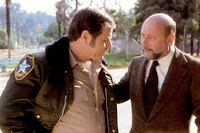 but a nerd knows a nerd by any other name would still dread bad grades. And who does Michael Myers kill? People who run rampant over the English language using 'totally' as flippantly as people today use 'literally.' And what greater confirmation do we have for the endorsement of education than having a doctor act as the arbiter of justice filling Michael Myers full of lead. That's right, a paunchy, bald guy with no less than three degrees gets to save the day. Is that me on the screen? Am I finally a hero?
So, thank you, John Carpenter but not for turning nerds into knights and finally giving me my place in the sun. That theory has more holes in it than any ten of your films. No, thank you for letting the horror-hating guy I am take a beating from the horror-loving guy I'd like to be. You've so brilliantly recreated my relationship to comics that I might have to give this horror thing a try...
Horror is a rather problematic genre for me mostly because I'm a snob. I hate the hokiness (hokeyness?), the gore, the predictability of the plot, but really what I hate is the idea that what I see on the screen should scare me. Heart attacks scare me, unemployment scares me, but a ridiculous puppet devising over-wrought methods of execution ala the Saw franchise does not scare me. Part of me realizes that this is my own shortcoming as a cultural critic and I hope to one day see just why horror is so good. The other part of me is shaking its head at that statement and wonders why this blog post isn't on Peter Greenaway's brilliant film about landscape drawing, The Draughtman's Contract.
Appropriately enough, my first horror review will be on one of the most cliched of all October films, Halloween. Today's in-class screening was the film that put Carpenter on the map and gave hundreds of scrappy, independent upstarts the incentive to make shitty movies. But what can I say about Halloween that hasn't been said in the film's nine 'sequels' or the dearth of scholarship written about the film or by people who put 'John Carpenter' in the same sentence with 'Alfred Hitchcock' when discussing great filmmakers? After racking my brain for minutes, I sadly came to the realization that perhaps Halloween should be dearer to me than I originally thought.
My favorite 'low' genre has always been comic books. Nerdy kids like to read and mostly we like to read about muscle-bound heroes with super powers that have earned the trust and respect of everyone around them. Namely, characters who represent everything we aren't. However, comic books see fit to mock their fanbase by having Captain Pectorial spend 30 pages using brute force to beat his foe, guy with brain/mental/doctor/professor/science in his name. To sum up, guy I want to be constantly beats up guy I am and I love him for it. But more on my self-loathing in a moment.
Ignoring the theory of the 'final girl' and gender studies for just a moment, I'd like to think about the film's views on education. Laurie escapes horrific death not because she's a frigid virgin, but because she's a nerd and smart people survive (to remain virgins) in the world of horror movies. What frightens Laurie early in the movie? Leaving her chemistry book at school and therefore losing scholarships that would get her a better education and thus a better job. Well, she doesn't come out and say that
 but a nerd knows a nerd by any other name would still dread bad grades. And who does Michael Myers kill? People who run rampant over the English language using 'totally' as flippantly as people today use 'literally.' And what greater confirmation do we have for the endorsement of education than having a doctor act as the arbiter of justice filling Michael Myers full of lead. That's right, a paunchy, bald guy with no less than three degrees gets to save the day. Is that me on the screen? Am I finally a hero?
So, thank you, John Carpenter but not for turning nerds into knights and finally giving me my place in the sun. That theory has more holes in it than any ten of your films. No, thank you for letting the horror-hating guy I am take a beating from the horror-loving guy I'd like to be. You've so brilliantly recreated my relationship to comics that I might have to give this horror thing a try...
Monday, October 5, 2009

Monday, September 14, 2009
Sukiyaki Western Django
You want to hear a funny story about Takashi Miike?
 Once upon a time, when I was a naive young movie snob, I had never heard of Takashi Miike. I was happy. I lived in a little house in a little town, across the street from my best friend, Dave. One Sunday, as I puttered around, looking for something to do, my friend crossed the street for a visit. "I can't stay," he said, "but I brought you something." He handed me a dvd he had burned. "Kristin and I watched it. I think it's...artistic." Then he left, and I looked down at the dvd in my hand, at the handwritten title: Audition.
When people hear this story, people who have seen Audition, they are amazed that Dave and I are still friends. They question my judgment. Sometimes they question whether I should still be friends with Kristin, since she could probably have known, and warned me.
Later that day, after I had watched the movie, Anna came to visit, and I remember her look of concern when she saw my face. "Are you okay?" she asked. Well, no, not really.
Audition might not be the scariest movie I have ever seen, but it definitely belongs on a short list of the most disturbing. Audition sneaks up on you (I can only speculate, but I suspect this would be true even if you knew its reputation beforehand), because the story is so ordinary, and then suddenly, without warning, extraordinary.
I don't really mean to talk about Audition, but the truth is that having seen a few (maybe half a dozen) of his myriad films, I still always think of Audition as the Miike yard stick, because Audition does so well what it sets out to do, which is cause anxiety.
 Sukiyaki Western Django does not aim to disturb. It belongs somewhere in the family of genre-exploding films, playing on the themes of B-westerns, but very much in the Tarantino mold* (as opposed to, say, the Kurasawa mold, or the Coen bros). This sort of film (Kill Bill, Death Proof), smirkingly points out that what we are dealing with is a traditional form, and leaves it at that. After watching these movies, a person doesn't come away with the sense that something has been said about that tradition (in this case, the western). If you love westerns, it is probably entertaining enough to recognize the homages and roll with the formula, and allow the movie to make up in style what it lacks in substance.
I guess Sukiyaki Western Django does what it sets out to do. I'm just not sure that what it sets out to do is all that interesting.
*and with his participation, including a quite hard to watch recurring cameo

When people hear this story, people who have seen Audition, they are amazed that Dave and I are still friends. They question my judgment. Sometimes they question whether I should still be friends with Kristin, since she could probably have known, and warned me.
Later that day, after I had watched the movie, Anna came to visit, and I remember her look of concern when she saw my face. "Are you okay?" she asked. Well, no, not really.
Audition might not be the scariest movie I have ever seen, but it definitely belongs on a short list of the most disturbing. Audition sneaks up on you (I can only speculate, but I suspect this would be true even if you knew its reputation beforehand), because the story is so ordinary, and then suddenly, without warning, extraordinary.
I don't really mean to talk about Audition, but the truth is that having seen a few (maybe half a dozen) of his myriad films, I still always think of Audition as the Miike yard stick, because Audition does so well what it sets out to do, which is cause anxiety.

I guess Sukiyaki Western Django does what it sets out to do. I'm just not sure that what it sets out to do is all that interesting.
*and with his participation, including a quite hard to watch recurring cameo
Sunday, August 23, 2009
Generic...

As the perhaps only person on this blogspot to go see Tarantino's newest film, Inglorious Basterds, I felt a certain obligation to write something about it. I'll leave better bloggers for what will no doubt be better films (Avatar), and humbly accept my fate as the lone Tarantino fan.
My normal defense for Tarantino's output rests almost entirely on his attention to the history of popular/pulp genres, and his suggestion that there is high art in the low brow. Jackie Brown, Kill Bill, and Death Proof reevaluated the importance of seedy cop dramas, poorly dubbed kung-fu features and car-chase films in the context of the history of cinema. Vanishing Point may never make it to Criterion's ranks, but Tarantino does present a compelling argument as to why it should not be immediately disregarded.
So why then does Inglorious Basterds fall so short? At first I thought Tarantino was a director so entrenched in the film making of the 1970s, he was ill-equipped to handle a "period" piece. Though Samuel L. Jackson narrations over Shaft-esque action sequences missed the mark in this film, they were at the least mildly entertaining. Ultimately, what fails this film is what has made so many Tarantino films so good: attention to the trappings of genre. When Tarantino wants to make a film, he consumes every film that might remotely resemble the anticipated project and plucks from each one a shot or a scene that gives the genre relevance. With a genre like car-chase films, you've got 5-6 films to work with and it creates a need for attention to detail to find the diamond scenes amongst the glass. Now Tarantino has nearly 60 years of films to choose from, and as you guessed he didn't want to leave one out. The movie itself is a reference to a 1978 film released under a similar title (this might illuminate part of the problem) but the citations don't stop there. Le Corbeau, The Great Escape, A Bridge Too Far, Saving Private Ryan, and most of the Leni Riefenstahl films make an appearance. The end result is a film with the most abhorrent nazi villain (Christoph Waltz is wonderful, wunderbar, merveilleux and meraviglioso), complex issues dealing with who is an enemy and a circus of bizarre antics that just don't fit (midget painters, Mike Meyers, etc.).
As this blog post is needlessly longer than it should be (emblematic of its subject at 153 minutes), I want to close on the film's lone saving grace. Tarantino's film challenges how genres don't seem to work over time. The war films of the 1940s aren't much like the war films of the 1950s and even less so when compared with films of the 1970s. Yet they are all found in the same section of your local video store clumped together without only the war as their unifying factor. As time goes on, we get films like Inglorious Basterds, a clear descendant of the genre but with a lineage we might expect of a true bastard: related but we don't know how.
Friday, August 21, 2009
Julie and Julia
 Julie and Julia was not our first choice for our inaugural Richmond movie experience. Of the movies currently playing, the only ones we really wanted to see were Humpday and The Hurt Locker, but they started too early. (I sort of thought moving to a bigger city would give us more choice in movies to see in the theater, but it turns out the same twelve movies are just playing at twenty different locations here.)
I can't help thinking of Julie and Julia as two different movies.
Julia
It is maybe redundant to even bother mentioning that Meryl Streep is a brilliant actress, but I can't help saying it again, because Julia Child is an impossible role. Everything about Mrs. Child was so huge: her personality, her height, her voice -- oh man, that voice. Who could play Julia Child better than Dan Akroyd? What I mean is, a perfect portrayal of her would almost have to play like a caricature. And that's how I felt at first. But then. I was convinced, and then I was drawn in, completely. Sincere, mature love stories are rare in the movies anyway, and this one is unconventional in many ways.
Oh, and Jane Lynch! It might be the most serious role I've seen her in (Or the first? Does Joyce Wischnia count as a serious role?), and she was perfect. There is this moment at the wedding, an overhead shot, that could have been cheesy, but it wasn't quite cheesy.
Julie
First I should say that I agree with everyone else on planet earth that Amy Adams is delightful and charming and adorable and everything. From Junebug to The Office to Enchanted to the recent Night at the Museum movie, she always seems to stand out, often as the only thing on screen worth paying attention to at all.
But this movie, the Julie half of Julie and Julia, I just can't get behind it at all. The characters keep talking about how narcissistic and selfish Julie is, but then they go on to reward and praise her narcissism. She talks constantly about how she was supposed to be a writer, but really, who thinks sloppy online babbling is writing? (To paraphrase Capote: That's not writing, it's blogging.) Seriously, is there anything more pointlessly unoriginal than writing a completely derivative blog, whose stated purpose is solely to respond to the creative work of someone else?
Jeez, fictional Julie Powell, get a life.
Subscribe to:
Posts (Atom)