Friday, May 31, 2013
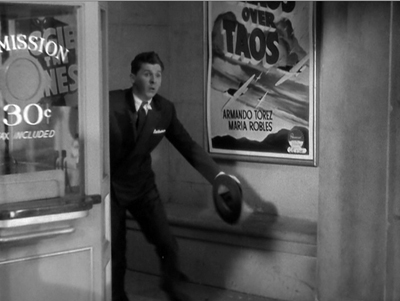
David Bordwell on Hollywood in-jokes
These movies were made by youngish people who liked to have fun–sometimes at each other’s expense—and nothing is more fun than very esoteric in-jokes.
http://www.davidbordwell.net/blog/2013/05/27/on-the-more-or-less-plausible-sneakiness-of-one-preston-sturges/
Thursday, May 30, 2013
Oblivion, etc.
Remember when we started NotThatCritical and we meant to write briefly and quickly, with no pressure, because no one would be reading it? I think it was supposed to be: 1) no more than five hundred words per movie, and 2) write something every single day. We never really kept up with every single day part, but, you know, like Maude said, consistency is not really a human trait.
I saw Oblivion a couple weeks ago. Well, "saw" is probably overstating it. I was present for it, although I might have fallen asleep once or twice. I did gather that it was about killer drones (topical!), and I can report that during the time I was awake, Tom Cruise occupied probably about 85% of the screen time. Maybe 90%. I remember just one scene he was not in, where stoned-eyed Andrea Riseborough (who seems familiar but imdb reveals nothing I remember seeing her in) talked with Melissa Leo, but I think their conversation was mainly about the Tom Cruise character, so it does not pass the Bechdel Test.
Speaking of Tom Cruise, I read this Vulture article a month or so ago, and I just saw Lindy West's response to it, which is, as usual, pretty much spot on. The only thing I need to add is that when they say "analyzed the data" they really mean, "made up a bunch of data points and wrote down some ideas about them." Which is cool, that's mostly what we want from Vulture, right? But this actual data exists--you can get all of imdb's data, for money--so is someone doing an actual analysis of actual data? Because that could be really interesting.
This research on gender and the movies was released recently from the Annenberg School: http://annenberg.usc.edu/Faculty/Communication%20and%20Journalism/~/media/5DB47326757B416FBE2CB5E6F1B5CBE4.ashx
This paper interests me, but this sort of analysis is necessarily so very subjective, despite best efforts. See for instance, from page 11:
I feel pretty certain that are fewer leading women in the movies now than there used to be, and fewer of those leading women are tough. But I have no real idea of how to objectively assess that statement.
I saw Oblivion a couple weeks ago. Well, "saw" is probably overstating it. I was present for it, although I might have fallen asleep once or twice. I did gather that it was about killer drones (topical!), and I can report that during the time I was awake, Tom Cruise occupied probably about 85% of the screen time. Maybe 90%. I remember just one scene he was not in, where stoned-eyed Andrea Riseborough (who seems familiar but imdb reveals nothing I remember seeing her in) talked with Melissa Leo, but I think their conversation was mainly about the Tom Cruise character, so it does not pass the Bechdel Test.
Speaking of Tom Cruise, I read this Vulture article a month or so ago, and I just saw Lindy West's response to it, which is, as usual, pretty much spot on. The only thing I need to add is that when they say "analyzed the data" they really mean, "made up a bunch of data points and wrote down some ideas about them." Which is cool, that's mostly what we want from Vulture, right? But this actual data exists--you can get all of imdb's data, for money--so is someone doing an actual analysis of actual data? Because that could be really interesting.
This research on gender and the movies was released recently from the Annenberg School: http://annenberg.usc.edu/Faculty/Communication%20and%20Journalism/~/media/5DB47326757B416FBE2CB5E6F1B5CBE4.ashx
This paper interests me, but this sort of analysis is necessarily so very subjective, despite best efforts. See for instance, from page 11:
All characters were evaluated for attractiveness. This measure ascertained whether one or more characters in the plot verbally (e.g., “You are so hot!”) and/or nonverbally (e.g., cat call, whistling, gapping mouth) indicated the physical desirousness of another character. Self references did not count. Characters were coded as not attractive (i.e., no verbal or non verbal references), attractive (i.e., one reference), or very attractive (i.e., two or more references). These latter two levels were collapsed prior to analysis.Makes me a little dizzy, trying to think of ways to make an objective character attractiveness criteria.
I feel pretty certain that are fewer leading women in the movies now than there used to be, and fewer of those leading women are tough. But I have no real idea of how to objectively assess that statement.
![]() |
| Ripley: tough (wikimedia.org) |
![]() |
| Katniss: also tough (www.fanpop.com/) |
Monday, July 23, 2012
Friday, July 20, 2012
Moonrise Kingdom
Moonrise Kingdom is shameless, non-stop kitschy nostalgia, and it is a weird nostalgia, because it is aimed at an audience that does not remember the stuff it is nostaligic about. It is a movie for the Etsy generation. An Instagram movie. It may be the Wes Andersonest of all the Wes Anderson movies, but I would not know, because I have only seen The Royal Tenenbaums and The Life Aquatic all the way through, and neither of them left much of an impression, to be perfectly honest. To be perfectly honest, I may have avoided the more beloved of his movies (Rushmore) because I fear the uncomfortable conversations in which I say horrible insincere-sounding things like, "Yeah, a lot of people like that movie" or "I really liked the shoes in that movie." (I'm terrified of hurting people's feelings, I'm terrified of being judged for my taste. Why am I writing stuff here on a blog about movies...?)
![]() |
| Wes Anderson: I put a bird on it. |
So I had no plans to like Moonrise Kingdom. I thought I would damage my eye-sockets with all the eye-rolling Moonrise Kingdom would require. However. I was totally charmed by it. I thought Ed Norton's Khaki Scouts troupe leader was funny and sincere and believable. Frances McDormand was great. The sweet naive sexuality and romance were flat and unrealistic in the way a good picture book is.
What does this mean?
Do I have to turn in my dried-up humorless cynic card?
SW&tH
What if told you there is a movie, in theaters now, with the following actors in it? Nick Frost, Eddie Marsan, Bob Hoskins, Toby Jones, Ray Winstone, Ian McShane.
You would think, that sounds like something pretty great, probably fairly violent, maybe a Guy Ritchie crime caper, or maybe some medieval epic, with lots of historical accuracy and very cool costumes. Or maybe you wouldn't think that because you don’t know all their names, but you know these guys.
See? Those guys. Maybe they would be working class weirdos in a Mike Leigh film. Maybe they would be the supporting cast in a new Danny Boyle sci fi movie. What you would probably not think is this: all those actors are the dwarfs in the second weak retelling of Snow White to come to theaters this summer. This is Snow White and the Hunstman, starring Kristen Stewart, Chris Hemsworth and Charlize Theron. Theron, by the way, is a phenomenon. I felt like everyone else understood that this was a silly movie--Chris Hemsworth especially seemed to maintain an ironic smirk the whole time. Maybe that's just his face, or his character. But Charlize Theron, I don't think she knows how to phone it in, and her performance is almost embarrassing because it's too good for the film she's in. Unlike Kristen Stewart. There is an amazing scene near the end of the movie, where Kristen Stewart gives a sort of St Crispin's Day speech, inspiring the troupes, but in that same face-touching, dead-eyed style of naturalistic acting that has occasionally worked really well for her, when she played a sullen teenager. "Iron melts," she growls, in a weird halfway English accent. "But it also writhes about inside itself." I have no idea what any of this means. But I would definitely like to be kidnapped by that band of dwarfs.
Wednesday, May 2, 2012
News about Oldboy is always interesting, but I'm fascinated by a couple of other things in this article:
1. Use of whom in the first sentence: "whom has been following this remake." It's a complex sentence, but still.
2. Martha Marcy May Marlene, Silent House, and Spike Lee's vision of Oldboy constitute a trend of "thrillers"? You have to make a pretty broad definition of genre to wedge those three movies into the same category. I guess it would be undiplomatic to say so, but I suspect what Elizabeth Olsen has an un-Olsenlike reputation for is "acting." Or more accurately, "not reminding me of Full House."
http://www.youtube.com/watch?v=D0KUUOWq3JA
1. Use of whom in the first sentence: "whom has been following this remake." It's a complex sentence, but still.
2. Martha Marcy May Marlene, Silent House, and Spike Lee's vision of Oldboy constitute a trend of "thrillers"? You have to make a pretty broad definition of genre to wedge those three movies into the same category. I guess it would be undiplomatic to say so, but I suspect what Elizabeth Olsen has an un-Olsenlike reputation for is "acting." Or more accurately, "not reminding me of Full House."
http://www.youtube.com/watch?v=D0KUUOWq3JA
The Westerfeld Effect
I had to look up this post again today, not for the last time I'm sure: http://scottwesterfeld.com/blog/2007/03/midi-nighters-on-tv/ .
Sullivan is really into My Little Pony right now. He says, "My little pony my best friend." So I was thinking, Sullivan is a brony. Only then I realized, Sullivan is two, so actually he's just a toddler watching a cartoon for toddlers.
I'm always trying to express this thing, where you twist a thing too many times and end up with something very conventional, either the same thing you started with or something worse. I think Scott Westerfeld explains the phenomenon really well, and since I often want a name for it, I think we should call it The Westerfeld Effect. Right?
Sullivan is really into My Little Pony right now. He says, "My little pony my best friend." So I was thinking, Sullivan is a brony. Only then I realized, Sullivan is two, so actually he's just a toddler watching a cartoon for toddlers.
![]() |
| brony tshirt |
I'm always trying to express this thing, where you twist a thing too many times and end up with something very conventional, either the same thing you started with or something worse. I think Scott Westerfeld explains the phenomenon really well, and since I often want a name for it, I think we should call it The Westerfeld Effect. Right?
Subscribe to:
Posts (Atom)


