My recent suggestion that you all start a regular screening of westerns for my education was not met with the unmixed enthusiasm I anticipated. But I'm trying again. People, I need to see westerns. I cannot understand other movies. Once when I was very young I saw Bronco Billy on TV when my mom thought I was asleep. I saw Drums Along the Mohawk in a course on Images of American Indians in Film. And while I would still argue that The Big Lebowski is a western, I don't think it really counts as, you know, canon. I'm pretty sure I've never seen a John Wayne movie all the way through. I mean, except this one.
I saw The American last weekend, and I think it was a Western, but I can't be sure. George Clooney is a crafty gun maker--a definite contender for the handmade Oscars this year, if anyone is keeping track--and maybe he's also an assassin, and he's hiding out in a tiny town in Italy. He is in a restaurant and a movie is on the TV, and someone explains (to us? to Clooney?) that Sergio Leone was Italian. Who knew!?
People love this movie, and I understand why; it's very beautiful to look at, whether you prefer looking at crooked Italian cities or implausibly beautiful Italian prostitutes or George Clooney's lean torso. I loved how silent it was (or...I would have loved it, had I not been trying to eat some nachos in a very crowded theater, but I can hardly blame Anton Corbijn's for the fact that the Bow Tie ran out of soft pretzels).George Clooney does this grave, understated, crafty thing, and he does it very well. There is a lot to like in the construction and the performances.
But it is also kind of a movie about cartoon butterflies. It is about redemption, and I'm not very interested in the character's redemption. There is a love story, but I don't understand why anyone loves anyone in this movie. There is a priest who has lots of aphorisms ("You cannot deny the existence of hell. You live in it.") and shadowy moral failings (I know, shocking). And, seriously, there are a lot of cartoon butterflies.
Wednesday, September 8, 2010
Wednesday, May 5, 2010
Justified

I love Westerns. Old Westerns (The Man Who Shot Liberty Valance), new Westerns (The Assassination of Jesse James by the Coward Robert Ford), Sci-fi Westerns (Outland), Australian Westerns (The Proposition written by Nick Cave?!), Czech Westerns (Lemonade Joe) and even Russian Westerns (The Elusive Avengers), which are called Easterns because they’re all about Siberia. I love Clint Eastwood, John Ford, Sergio Leone, Yul Brenner, and Cleavon Little. I pretty much love everything about Westerns with one major exception: Marion Mitchell Morrison. But at least Bruce Dern shoots him in The Cowboys.
I guess what I find to be most appealing about the genre is really something that isn’t expressly revolutionary or exciting. In my mind, Westerns are all about our desire for justice and going beyond the reasonable and moral limits to enact it. If nothing else, Westerns show us that deep down inside even good people are murderers, and we fully support even the most despicable acts if they are “on the side of the law.” In Westerns, democracy, the law, and morality are all proven to be nothing more than a facade and humans are just atavistic beasts who haven’t evolved. Or, as Ike Clanton puts it in Tombstone, “Having that badge don’t make you right.” Just like Timothy Olyphant’s character in Justified.
Everything about Olyphant’s character conjures up the vigilante of old (yes he wears a cowboy hat and everyone talks about it, yes he wears a hip holster and is a quickdraw artist), but at work in a world that has no use for such barbarism. Of course the plot is cliched, but Elmore Leonard is just the writer to turn the cliched into the interesting and entertaining show that Justified is. Did I mention the show take place in Kentucky and makes Kentucky seem like an interesting place?
Ignoring the hat and boots, Olyphant has all the necessary traits to be a great Western sheriff. He’s a roguish gentleman, he believes in traditions, he’s honest and a natural leader. Allow me to translate. He’s a chauvinist, conservative technophobe who doesn’t mind sacrificing anything and everything to get an arrest. Oh, and as far as honest goes, in a recent episode he states that he’d rather, “stick [his] dick in a blender,” than go to a gallery of paintings by Adolf Hitler. All in all, I think Justified is going to be a solid show because, unlike Westerns where vigilante justice tries to right the lawless society, Justified is all about the vigilante in a hyper-legal society. There is no better expression of this change in tone than the way everyone talks about the way Olyphant gunned down the hitman in the first episode. In Justified, shock has replaced awe, but it’s still all about terror.
Monday, March 22, 2010
The Crazies (2010)
There are a lot of reasons to remake a movie, none of them very good. Sometimes there have been so many sequels already that the only way to continue the franchise is to restart it. We have seen a rash of these in recent years, Nightmare on Elm Street being the newest (note: I don't approve of rebooting the franchise, but I sure do like the idea of Jackie Earle Haley as the new face of Freddy). Sometimes a movie has a small but loyal following and the filmmakers hope to gain a wider audience for something they consider great by releasing a new version of it. Or technology has changed since the time of the original, and the filmmaker feels he can make a better-looking version of the same story. I suppose this is what justified remaking King Kong. Perhaps the hardest remake rational to argue with is when the original director himself remakes his own film, as Michael Haneke did with Funny Games last year. If anyone has the right to tamper with the legacy of a film, surely the director does. But if you go down the road of creator ownership, eventually you will run into George Lukas, and you will have to admit that just because a person created something, that does not mean he understands it.
The Crazies was not remade for any of these reasons. Director Breck Eisner approached the project with the question, "What would George Romero have done with this if he had had more money?" So far so good. First, he hired real actors. Fine. He added big explosions. Fine again. Then he edited out all the really terrifying parts. You know, the horror.
It's been a long time since I saw The Crazies. I saw it only once, and I remember it for one reason: because it was horrifying.
The Crazies was very much in the Romero mold: mysterious illness infects a population, no one knows who to trust, a small group of unconnected people are thrown together in rural Pennsylvania, where they all turn on each other. Ugly things happen. Some not-very-subtle points are made about human nature and/or politics and/or society. Very ugly things happen. Roll credits.
The remake of The Crazies is a perfectly adequate epidemic movie. Timothy Olyphant is a likable small-town sheriff, Radha Mitchell is a likable extremely hot small-town doctor. Joe Anderson (who I did not remember from the three movies imdb tells me I've seen him in) was very convincingly not British. There are jumpy moments, and big fires, and one pretty cool scene in a carwash. But I will forget all those things pretty quickly. I will never forget a certain scene from the 1973 movie. If you've seen the old one, I bet you know exactly what I'm talking about.
p.s. Was it the music or the hand-held camera or the hot teenagers that made me think more than once that I was watching an episode of Friday Night Lights? Am I the only person who had this experience? The Internet says I am.
Labels:
epidemic,
George Romero,
Horror,
remake,
The Crazies
Monday, January 25, 2010
Post-Birthday, Post-Apocalypse....
If I learned anything from the Hughes Brothers' The Book of Eli, I learned that three things will survive the apocalypse. First and foremost, the violence, hatred and ignorance brought about by religion will survive us all well into the sun-scorched deserts of post-apocalyptic America. Wait, that's already three things. Let me start again, the five things that will survive the apocalypse are those three aforementioned principles of religious thought and advertising. Appearances by Dr. Dre's headphones, iPod, J. Crew (skinny jeans fit better when you're on a steady diet of cat meat), the Coffee Beanery, GMC, and Puma remind us of the sins of materialism and as Eli tells Solara, "Then, people threw away what people today kill each other for." But there is hope. For in the future with the voice of God ringing in our ears and advertising clouding our vision, there will be a prophet to lead us. No, it's not Denzel Washington or Mila Kunis who will murder anyone who might stand in the path of God's doing. And it's not Gary Oldman who rightly believes that the Bible is "a weapon." No, we humble sinners have found a voice, a gravely voice, the voice of Tom Waits.THE BOOK OF ELI: Ohhh Sweet - The best video clips are right here
To be serious for a moment, I'm a fan of the Hughes Brothers and I thought Dead Presidents and From Hell were impressive films. If nothing else, the Hughes Brothers tried to defy the notion that directors should work within a genre or specific style. When the trailers of The Book of Eli hit Apple's website, I felt justified in maintaining this stance and I don't think I'm wrong, yet. Because as much as this film is about the hope and resolve given to Eli in his quest to protect the Bible, there is no question as to the moral hypocrisy that comes with it. Eli is violent and unforgiving arbiter of God's will and he kills upwards of forty people on his quest. At times he's called on to protect the defenseless but this isn't always the case. Early in the film Eli watches the murder and rape of two travelers muttering to himself, "Stick to the path, stick to the path," only to deviate from this "path" and save Mila Kunis from a similar fate. Why Eli chooses to save one over the other is perhaps only explained by the fact that Kunis's character is a believer and the others did not yet know the Word. Ultimately, this film is an Old Testament parable about the might and power of God, and it doesn't leave out the hatred and intolerance that comes with it. I guess you could say it renewed my 'faith' or complete lack thereof.
Saturday, December 12, 2009
A Serious Man
Kristin and I just watched A Serious Man with some degree of enjoyment. I equivocate because I still haven't really thought the film through (I'm somewhere about the first time Larry Gopnick calls Columbia Records Album of the Month Club). However, most of the film is what I've come to expect from the Coen Brothers, but it did get Kristin and I thinking about putting together a film retrospective. Here's my tentative line-up. If you notice something clever about a combination, of course it was my first thought.
On to the list. The first night consists of the latest films, which I think are the same film or at least the same ending. The second night will be a date night, third night - westerns, the fourth night - a battle of Johns (Turturro and Goodman), and the fifth night on the dangers of industry. The sixth night will be all about Frances and the final night will be my favorite of bunch.
Submit your restrospective and let the 'dualing' begin...
Oh, and in honor of having finished teaching Russian film for the quarter, I will include a review for A Serious Man: Many movies deal with problems of society and families and this is interesting in A Serious Man.
- Burn After Reading and A Serious Man
- Intolerable Cruelty and Raising Arizona
- Big Lebowski and No Country for Old Men
- Barton Fink and O Brother, Where Art Thou?
- The Hudsucker Proxy and The Man Who Wasn't There
- Blood Simple and Fargo
- Miller's Crossing
On to the list. The first night consists of the latest films, which I think are the same film or at least the same ending. The second night will be a date night, third night - westerns, the fourth night - a battle of Johns (Turturro and Goodman), and the fifth night on the dangers of industry. The sixth night will be all about Frances and the final night will be my favorite of bunch.Submit your restrospective and let the 'dualing' begin...
Oh, and in honor of having finished teaching Russian film for the quarter, I will include a review for A Serious Man: Many movies deal with problems of society and families and this is interesting in A Serious Man.
Saturday, December 5, 2009
Zombieland
The walking dead should walk slowly. They should not run. Think of these corpses, raised from slumber by some unknown and incomprehensible force. They are new to this form of locomotion, and their muscles do not respond as expected. Wanton disregard for their own well-being has, in many if not most cases, caused them to sustain multiple injuries. Even if they feel no pain (and “zombies” do not feel pain in the way we do, although they may feel something), they cannot run on a broken ankle, or a torn achilles. Poor zombies.
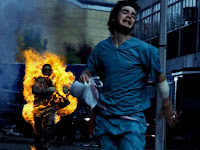
But it seems zombies have been working out. More and more, the undead are portrayed as faster and stronger than the living humans they subsist on. These fast-moving flesh eaters can be scary in their own way, but they are more like the old monsters: werewolves, or yetis, or lions and tigers and bears. They are predators, and we can escape them through our superior wits and technology, but we cannot outrun them, because they are essentially the same beasts we have feared since we first stood up on two legs. Zombieland’s undead are decidedly in this latter category, the athletic undead.
What makes the living dead of the classic Night of the Living Dead scary is not simply the fact that have been reanimated. Nor is it their modified cannibalism (Question: is it technically cannibalism when they eat only the flesh of living humans and never each other?), although the images of vacant-eyed undead masticating arm muscle certainly produce some visceral reaction. The truly frightening—and new—thing about Romero’s undead comes from their weakness, the fact that individual zombies are so easily eluded or defeated. It does not matter that you can outrun the shambling corpse in the graveyard—and you certainly can—because there will be another near the car, or behind a tree, or looming up out of the darkness in your front yard. There will always be another.
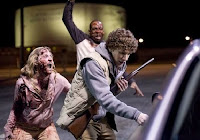
That Zombieland features zombies who run is a failure not of Zombieland itself, but of the entire zombie genre to which it is a response. Zombieland is a movie about zombie movies, and in the cultural contest between high-speed, Danny-Boyle—style undead flesh-eaters and the lumbering living dead of Night etc, it is pretty clear that the scarier and more interesting slow zombies have already lost. Zombieland is the proof, because Zombieland exists in a cultural setting where an explanation of the plague—what caused it, how it spread, where it started—is almost irrelevant, and certainly unnecessary. Everyone knows what a zombie is.
Zombieland is not a bad movie. Every aspect of the film does what it means to do; it is funny, romantic, gory, smart. The performances are strong, especially one awesome (and often spoiled, but far be it from me…) cameo. Here is Jesse Eisenberg, still playing the same thoughtful, neurotic descendant of some hybrid of Woody Allen and Holden Caulfield that he has been playing since he was tiny (and here I am again, sort of liking him in spite of the fact that I was sure I had heard enough stories about how hard it is to be a smart, introspective, adolescent white boy growing up in middle America). And here is Abigail Breslin, who no longer looks like a little girl, trading one-liners with Woody Harrelson.
Like in the superior Shaun of the Dead, the zombies in Zombieland are mere background, in this case for a family road-trip action comedy (sort of like a National Lampoon’s Summer Vacation, with automatic weapons). Unlike Shaun of the Dead, Zombieland has no rough edges. It is slick and fast and full of self-confidence. Maybe that is the difference between the zombie movies Zombieland is responding to and the Romero family of zombie movies (which SotD is about); Romero gleefully explores a crazy idea, while the fast-zombie movies are sardonic and a little smug, and their underlying idea is ultimately safe.
For lovers of Night of the Living Dead, there is something sad about Zombieland. It feels like a nail in the coffin of the thing Romero invented, which was maybe the first new thing in horror in a century. The shambling, slack-jawed, vacant-eyed animated corpse that feeds on the flesh of the living, that can be killed with a shotgun blast or a good solid blow to the head, that can be outrun by any child, but can never be defeated because the one thing this threat requires to keep coming is the one thing we will never stop providing: more corpses.
But it seems zombies have been working out. More and more, the undead are portrayed as faster and stronger than the living humans they subsist on. These fast-moving flesh eaters can be scary in their own way, but they are more like the old monsters: werewolves, or yetis, or lions and tigers and bears. They are predators, and we can escape them through our superior wits and technology, but we cannot outrun them, because they are essentially the same beasts we have feared since we first stood up on two legs. Zombieland’s undead are decidedly in this latter category, the athletic undead.What makes the living dead of the classic Night of the Living Dead scary is not simply the fact that have been reanimated. Nor is it their modified cannibalism (Question: is it technically cannibalism when they eat only the flesh of living humans and never each other?), although the images of vacant-eyed undead masticating arm muscle certainly produce some visceral reaction. The truly frightening—and new—thing about Romero’s undead comes from their weakness, the fact that individual zombies are so easily eluded or defeated. It does not matter that you can outrun the shambling corpse in the graveyard—and you certainly can—because there will be another near the car, or behind a tree, or looming up out of the darkness in your front yard. There will always be another.
That Zombieland features zombies who run is a failure not of Zombieland itself, but of the entire zombie genre to which it is a response. Zombieland is a movie about zombie movies, and in the cultural contest between high-speed, Danny-Boyle—style undead flesh-eaters and the lumbering living dead of Night etc, it is pretty clear that the scarier and more interesting slow zombies have already lost. Zombieland is the proof, because Zombieland exists in a cultural setting where an explanation of the plague—what caused it, how it spread, where it started—is almost irrelevant, and certainly unnecessary. Everyone knows what a zombie is. Zombieland is not a bad movie. Every aspect of the film does what it means to do; it is funny, romantic, gory, smart. The performances are strong, especially one awesome (and often spoiled, but far be it from me…) cameo. Here is Jesse Eisenberg, still playing the same thoughtful, neurotic descendant of some hybrid of Woody Allen and Holden Caulfield that he has been playing since he was tiny (and here I am again, sort of liking him in spite of the fact that I was sure I had heard enough stories about how hard it is to be a smart, introspective, adolescent white boy growing up in middle America). And here is Abigail Breslin, who no longer looks like a little girl, trading one-liners with Woody Harrelson.
Like in the superior Shaun of the Dead, the zombies in Zombieland are mere background, in this case for a family road-trip action comedy (sort of like a National Lampoon’s Summer Vacation, with automatic weapons). Unlike Shaun of the Dead, Zombieland has no rough edges. It is slick and fast and full of self-confidence. Maybe that is the difference between the zombie movies Zombieland is responding to and the Romero family of zombie movies (which SotD is about); Romero gleefully explores a crazy idea, while the fast-zombie movies are sardonic and a little smug, and their underlying idea is ultimately safe.
For lovers of Night of the Living Dead, there is something sad about Zombieland. It feels like a nail in the coffin of the thing Romero invented, which was maybe the first new thing in horror in a century. The shambling, slack-jawed, vacant-eyed animated corpse that feeds on the flesh of the living, that can be killed with a shotgun blast or a good solid blow to the head, that can be outrun by any child, but can never be defeated because the one thing this threat requires to keep coming is the one thing we will never stop providing: more corpses.
Labels:
28 Days Later,
Danny Boyle,
George Romero,
Romero,
Zombieland,
zombies
Subscribe to:
Posts (Atom)
